Showing posts with label books. Show all posts

Saturday, December 31, 2022

2022: Year in Review

I'm not really feeling ready to set big goals for this upcoming year, but I do feel like I want to pause and take stock of this past year. In many ways, this year felt stressful and rushed. However, it was also a year of blossoming children, substantial professional growth, deepening friendships, and caregiving for two adults. And while I may not have done all the things I hoped to do for myself, I feel that the life I'm living is pretty great.

Blossoming Children

I am in awe of my two kids, now 7 and 11. They have both become readers with confidence and passions--sharing books is a great joy (we all really loved discovering the Wings of Fire series by Tui Sutherland this year). For taekwondo, the oldest earned his black belt and the youngest her intermediate level purple belt in 2022. Their Destination Imagination team won first place in the Maryland state tournament, and I traveled (after a wild month of fundraising and travel planning to do so) with them to Global Finals in Kansas City--which was a really amazing, healing experience for my kids--whose school lives had been dominated by the Covid pandemic in the prior two years.

Celebrating their journey and learning with other Maryland DI Teams!

They also participated in summer swim team for the first time, and loved it. Each is growing into an interesting and unique young person. I enjoy spending time with both of them, especially with playing card and board games or going on nature walks. Raising children is not an easy task--it is relentless, unforgiving, and (often) unpleasant--especially during challenging phases, illnesses, or tough times. But I'm very lucky my kids are doing well overall.

Professional Growth

During 2022, I completed 21 of my 60 doctoral degree credits (gearing up to study for comprehensive exams in January and then moving into ABD territory during 2023). Even more amazing was how much I've grown as a leader, researcher, and educator along this journey. I have also developed some close relationships with the other students in my classes and cohort (our five-person writing group made time to meet up during break at the National Harbor & it was delightful to see people in person!). Going back to school to get my doctorate at age 40 was a wild decision, but I'm glad I'm on this journey.

My programs have seen massive growth and equity-focused expansion. I've also had the joy to work with some amazing students, teachers, counselors, leaders, and higher ed personnel who are committed to improving student experience of the high school to college transition. Finally, the education law in Maryland is going through a lot of changes and my involvement with state-level coordination and implementation of the change has been exhausting, but rewarding. I continue to be excited by my career and feel blessed to have the opportunity to work for children in this way.


Touring the (gorgeous!) University of Minnesota's engineering library while in St. Paul.

I also was fortunate to attend two conferences this year (one in Frederick and one in Minnesota) and met several national leaders in my field, as well as connecting with them in new ways through my doctoral work.

This year has seen a great deal of transition with the leadership above me, often creating anxiety and unanticipated challenges. We seem to have settled in a good place as this year draws to a close, but there were many times in 2022 where the action (or inaction) of a new, ineffective, or malicious senior leader threatened to impact the opportunities afforded students, and I felt extremely frustrated with myself for being unable to navigate all of it well. This has been a very, very challenging year for educators--and students--at every level (a sort-of normal year, but with all the traumas of a pandemic still lingering). I'm not at all surprised to see people leaving the field entirely.

I hope 2023 proves to be a better year for everyone in schools.

Deepening Friendships

I have friendships with several women who live locally that I feel have become chosen family. Our family networks are deeply intertwined--for the most part, the kids and adults all get along well with each other. We spend lots of time together--hanging out at each others' houses or going on adventures/outings together--without some of the pressure that can come with adult friendships. I am extremely grateful to have them in my life. (Note: One member of this group has moved away, but we still connect frequently thanks to chat and other distance communications. She's had a year of big transitions, and it's hard not to be able to surround her in the love, community, and support she deserves. But she is a survivor!)

Just one example, some of our kids, at the county fair, with friendship bracelets.

I was also able to visit a friend I had not seen in many years (who I met through this very blog--NOT KIDDING!!!--while we both lived in Korea) while I was traveling for a conference to Minnesota. This trip was very life-affirming and healing--especially connecting me back with my writing self (hopefully for us both). Recognizing how think I need to commit to in-person connections again with these long-time friends who still chat/text/phone/email, but haven't really been able to see for a few years. I felt this when I attended a high school program reunion this summer, too, and spent some time catching up with friends.

I'm also feeling more connected this year to communities than I have in a long time. Whether through volunteering at our kids' school, commiserating about graduate school coursework, collaborating on something professionally, discussing issues in social media, or dancing together in social dances or fitness classes, I feel rich again with a casual/acquaintance-level social network. I think this is the layer of relationships that suffered the most from Covid restrictions.

Caregiving

My mother had a stroke in August 2020, and while she lives independently in a condo a block away from our house, her recovery to independence is incomplete. It's been a bit of a rough year as we attempted to navigate her getting back to driving, but have not been able to do so yet. This journey was further complicated by the financial emergencies of my two adult siblings who my mother still feels the need to support. I'm not going to get into family dynamics here, but caregiving for a parent while being estranged from a sibling because he has past financial abuse of that parent while the parent continues to enable the abuse is... something. I continue to have to do really good boundary work and values clarity. I am grateful for the opportunity to have this relationship with my mother and help her live well, but it is NOT easy to balance it all.

Meanwhile, in early April, Mingi had surgery on his right foot to resolve several issues from a soccer injury two years ago. The recovery and the subsequent physical and emotional ups and downs from this have also triggered migraines and injured the left foot from overuse. He's not as reliant on others as my mother is, but our whole family has been impacted by his ongoing health challenges and recovery. Our network of friends and acquaintances has been invaluable through this recovery period, but it has been a struggle. We are definitely looking forward to a year where we can all do more together (hiking, traveling, silly fun), and Mingi feels more like himself.

Visiting the Inner Harbor in Baltimore this week felt a bit like maybe we are back to more normal ways of being for our family.

Overall, I'm proud of what I've been able to accomplish this year and grateful for the support in overcoming challenges we've faced. Having a stable financial situation and supportive network has made a major difference; at another time in my life, the challenges of 2022 would have broken me. Instead, I feel content that I was able to give the people I love so much care, love, and support. However, I have gained another 10 lbs in the last year (on top of the 20 I had put on in the prior years), and really need to put more focus into my own health so I'm able to continue to support others and do the things I want to do.

As such, I'm setting an intention this year of ensuring that I'm giving at least equal care and support to my own health and development that I give to my family.

How was your 2022? What are your New Year's intentions? Please share!

Tuesday, February 1, 2022

Raising Readers

I love reading. I've always known that I wanted to raise my children to be readers. It's a great frugal form of entertainment, and the most critical skill for success in school. In my career as a high school English teacher, I have helped convert hundreds of reluctant, phone-addicted high schoolers into teens who voluntarily read novels. I've convinced students that Will Shakespeare was a pretty cool dude. Yet, when it came to my own children, I was afraid I wouldn't be able to equip them to view reading in the way that Harper Lee once described in To Kill a Mockingbird:

"Until I feared I would lose it, I never loved to read. One does not love breathing."

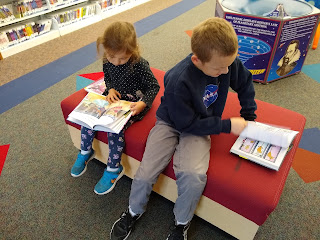
In the library, pre-Covid; still one of our favorite places to hang out!

Luckily, I need not have feared. My son just finished a five book series of 500+ page novels he received as a Christmas present and my daughter is making her way through several different series. Their most recent test scores from school peg their reading levels at 3+ grades above their actual grades. They are readers! Helping my kids become readers was easier and more enjoyable than I could have possibly imagined. I come from an education background, so of course I advocate that families read to children early and often and model literacy. Turns out, that actually works!

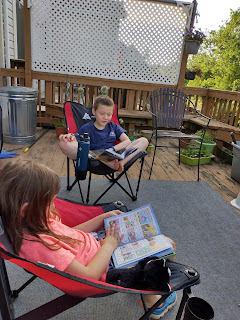
Lazy summer deck reading.


As a parent (who feels like she's making it all up as she goes along...), I've also discovered that reading to your kids stops meltdowns in their tracks and provides instant family bonding.  Here are some specific ways to develop young children's literacy:


  1. Make the time. Before I had kids, I was understanding about how hard it was as a parent to make time for reading. After all, I love reading, and I don't always make the time to do it. Parents are even busier, right? Y'all--I timed it. Reading one of those little board books takes less than five (yes, FIVE) minutes. And often it's the five minutes during which my child is most cooperative, loving, and attentive. No one screams. Everyone cuddles. Five minutes. It's better than meditation--no lie. How do you not make time for that every, single day? If I hadn't read to my kids, none of us would have made it past age two.  My worst nightmare is a bedtime without books. *shudder*

  2. Make books accessible.*  Studies show that being surrounded by books in childhood promotes literacy.  We own a lot of children's books (way more than adult books, thanks to my decluttering efforts). Most of them were gifts or hand-me-downs, but books are the main "toys" we have purchased for our children. However, you don't have to own books to surround your children with books.  Our local library lets patrons check out unlimited items, doesn't charge fines, and allows you to renew materials online. We usually have at least 60 books checked out at any one time--and only like 3-5 of them are for the adults. You can also buy used books or source them through Buy Nothing and Freecycle.

  3. Make it a habit. Every time my kids beg for "one more poem" or to be allowed to choose one more picture book or read one more chapter in our novels, I feel like I've won the gold medal of parenting. However, that joy comes from many, many times of being willing to read the same book over again, or pause and read whenever one of my children asks. We treat nagging for books different than just about every other kind of nagging--we indulge it.

  4. Give kids choice and agency. Sometimes, I get lucky and my kids are interested in the books I enjoy reading, and we'll have great fun with the works of Roald Dahl, Narnia, and Mossflower. Other times, they want to read endless, technically-oriented volumes about Pokemon (J) or the terribly-written picture book re-telling of Disney princess movies (H).  When the kids are interested in something (be it Kung-fu Panda, or space, or unicorns), we ask the librarians if there are any books about that topic and use Goodreads to find similar recommendations.

  5. Model reading books. I think many adults read more on screens (Kindle, smartphones, etc.) than they did just a few years ago.  However, children don't know whether you are reading on your tablet or watching a video.  Be intentional about modeling your reading to your children. Min had to get some Korean books so that the kids could see him reading on paper, not just on the screen.


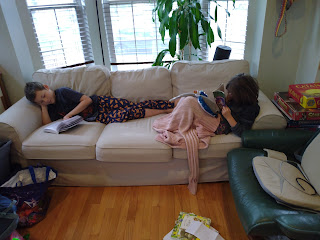
Snuggly winter couch reading.

Some other tips? Teach letters and sounds, but not to the point that you are sacrificing story and fluency. Readers read content, not phonics.  Don't freak out if your kid who loves listening to you read doesn't transition to reading independence right away. It will happen eventually. The boy who just tore through those 500+ page books didn't read anything but Dog Man independently well through second grade.


* Not every family can afford books. I encourage using the library to fill in the gaps, but that's not always enough.  While compiling this post, I did some research into charities that provide books to kids. I elected to make a donation to Reach Out and Read, an highly rated organization that encourages literacy by integrating books into pediatric care.


We also donate monthly to our local library. We get way more value from it than we do from any streaming media service.


Any other tips from parents out there? How do you foster a love of reading for your children at any age?

Tuesday, January 25, 2022

Food, Exercise, Nature, and Joy: Health in 2022

Last year work, household, caregiving, and grad school obligations became overwhelming. I found it difficult to make time for exercise and cook healthy foods; I also resorted to stress-eating late at night or picking up fast food. I gained about 20lbs before my brain cleared enough in late October to deal with this neglect of my physical state.

Neglected building along my walking route.

I will admit that there was a part of me that had surrendered--an inner voice that told me I would just "get healthy again" after my doctorate was finished. Then, I read the book Die With Zero by Bill Perkins. This personal finance book proposes that many super-saver ways of conceptualizing money for retirement (always "max out" accounts and optimize savings rates) are not the smartest way to approach finances because you could end up very wealthy, but without the time or health to enjoy what you've accumulated. Ultimately, Perkins advocates that money should be used to maximize fulfillment and experiences over time. Although much of his argument would only apply to those with privilege and comfort enough to be saving too much for retirement and there were some ableist tropes that have been called out on Twitter, I found the book shook me out of a money and health script that had me making bad tradeoffs. Perkins framed our mortality and the decline of our abilities and interests with age in a manner that made me realize how problematic it was for me to wait until some other part of my life is done to care for my health. I want to be able to enjoy my life--now and in the future--and neglecting health is probably the main guarantee that I'm stealing from my future enjoyment. (His book also made me relax a lot about retirement contributions and add life-fulfillment goals into my financial plan, which I really needed to do.)

Noticing a woodpecker on a nature walk.

I reckoned with the fact that I'd been "trying" to lose the weight I'd gained without success on my own; I rejoined WW, which has helped me lose weight in a healthy way in the past, I also recommitted to daily movement that I love--choosing to focus on all the ways I enjoy moving (dancing, walking, hiking, swimming, yoga...) instead of trying to force myself to do exercise I thought I "should" be doing (like jogging and weightlifting). I'm also conceptualizing wellness more broadly by paying attention to the quality of my relationships, prioritizing interactions with friends and family that bring me joy, and trying to spend time in nature really enjoying it.

J is very proud of learning how to solve Rubik's cubes after watching Youtube videos.

Even through the holidays and the stress of Omicron, I have been able to reconnect with the actions and habits that make me feel energized and strong. I have lost about 8 lbs., eaten less fast food and snacks, and exercise nearly daily. I feel much better! Right now, I am enjoying the 30 Day Yoga Journey MOVE from Adriene Mishler. On Twitter, a group of mostly women from my personal finance blogger friends keep me accountable as we cheer each other on with the hashtag #pfyogacrew (anyone is welcome to join in the fun!). I'm remembering not just how much yoga is lovely for meditation and stretching, but it really develops strength and stability. I think I would like to keep up with this as a daily practice beyond the 30 Day challenge.

How are you staying healthy through this difficult time?

Friday, December 31, 2021

Random Reflections as 2021 Closes

We have come to the last day of a very stressful year--which, coincidentally was the first year of my 40s and another year of very strange world events--from an ongoing pandemic to political shenanigans to climate crises to the dehumanization from the patriarchy, white supremacy, global capitalism, and other injustice. There is much from this year that leaves me sad, anxious, and helpless. I try to focus on the positives--vaccines and books, for example. But I will admit that 2021 on a broad scale leaves even silver-lining optimist Diana feeling a bit stretched to come up with much to say about the positive.

Super grateful for my wonderful family.

On a personal scale, I can find a lot more victories and joys. Here are a few:

Financial: Thanks to the largesse of the US government stimulus money, I finally paid off all my credit card debt. In a further debt victory, the rules for Public Service Loan Forgiveness were changed such that it looks like I will be eligible for full forgiveness of my undergraduate and master's degree loans in full. This has enabled us to increase our charitable giving & direct aid to family/friends, contribute more to retirement funds, and spend without worrying on the things we value. Life without crushing debt really changes your outlook. I also found Die With Zero and I Will Teach You to be Rich to be helpful books for this new stage of my financial journey.

Relationships: It was my first full year thinking of myself as a "caregiver" to my mother whose stroke in August 2020 has left her more dependent on others for help. I am proud and grateful at the amount of care I've been able to provide for her. This shift in our relationship has enabled me to reflect on what is most important and let go of more small slights. I feel solidly like a middle age adult, and I think this identity has a lot to do with it. I have rekindled a friendship with my sister who has helped with the caregiving and let go of the relationship with my brother that has always been toxic and strained.

Bringing Mom on vacation to the beach was a major 2021 highlight!

I also deepened my friendships with the women in my book club and their families (all of whom are mixed race, with one Asian, one white parent, such that our children all look more like each other than we do). These friends have become my go-to people. I am so grateful for this group we have built where I feel accepted and built a close community for my biracial children. have also become closer to a few work colleagues, parents of my kids' friends, dance friends, and neighbors this year.

Although I let my blog Free, Fun, Family lapse and haven't been writing as much, I feel connected to several online communities through Twitter, which is now my only social media besides Goodreads. I do hope to reconnect at in-person events with them in the future.

Professional: I am now through two full semesters of work on my Ed.D. program in Educational Leadership--and I love it! It's got me thinking and trying things in different ways that have already resulted in some pretty awesome collaborations and projects at work. It's also been a great outlet for managing, processing, and reflecting on the trauma of these last few years. I find myself re-inspired for educational work in a time of incredible challenge and difficulty in this profession. Although it can be very stressful at times, I'm so glad I decided to pursue this program at this time. I am also becoming close with a number of people in my cohort.

Bringing dually enrolled English Learner students on a tour of campus--many are first gen!!!

Reading: Thanks in part to my daughter's embrace of The Magic Treehouse series towards the end of they year, I made it to my goal of over 100 books in 2021 (as of right now, I'm at 111 and will probably finish at least one more book today). One of my goals was to increase my usual rate of 20-25% books by writers of color, and 43 of those books (38%) were by BIPOC authors. In reviewing my read shelf, I see that most of my books for grad school and my kids' read-alouds were not very diverse. I can't do much about the required reading for grad school (except continuing to advocate for different authors & choosing diverse authors when given a choice), but I think I need to be more intentional about getting my kids books by writers of color. Especially now that they are both independent readers.

So overall, a year of growth and development. Much to celebrate!

Of course, what I am most grateful for and proud of is the growth and closeness of my family. This year's struggles have resulted in a closeness and joy. I can't wait to see what 2022 brings for us!
Harper's Ferry visit with my Uncle Tom!

I've been less pleased with my year in terms of health (I gained weight with how stressful this year has been), minimalism/anti-consumerism, and writing (other than school, I didn't do much this fall). As such, these are the three areas I am focusing on for 2022 "goals."

Goals for 2022:
1. Lose the 20lbs I gained in a healthy way (whole foods, less dining out, more movement, smaller eating window/semi-IF). I'm not really all about the weight anymore & care way more about health, but I know that this weight impacts my diabetes control and makes dancing & hiking a bit harder.
2. Avoid Amazon (which we *still* use far too often), minimize Walmart, more food that's local, & declutter--for realsies.
3. Publish once a week in this blog. Sometimes it's gonna be short, sometimes long. But I have to build my writing muscle again, and I enjoy blogging here. It feels low stakes. Please hold me accountable.

Thank you for reading my thoughts, as always. I hope you are well as the year closes. Do you have any reflections or goals for this year? I'd love to hear them.

Thursday, June 7, 2018

Book Review: Meet the Frugalwoods

Originally Posted on 

I enjoy reading books by bloggers I admire because it makes me hopeful that this practice in writing that I enjoy so much could be one way to make the hobby I love a profession.  I have read a bit of Elizabeth Willard Thames’s Frugalwoods blog on and off since she started it back in 2014.  Her eschewing of the dangerous, unhealthy consumerist culture in the U.S. (while still functioning within that society) is something I have struggled in reaching my own personal goals.  I enjoyed reading even more when she became a mom and achieved her dream of homesteading, which is also when her blog picked up in popularity.  However, I was delighted to see that her first book was published in March–right when I began to get serious about my return to blogging!

Thames and her husband have achieved financial independence at an early age through a combination of hard work, frugality, and vision. Meet the Frugalwoods: Achieving Financial Independence Through Simple Living is the story behind the blog posts. I loved the story! I enjoyed parts of the book that rounded out the story–the details from her time as an Americorps VISTA volunteer and the process of buying the homestead and then settling into it were particularly interesting.

Thames is aware (and acknowledges) that she was in a privileged position to reach her goal, which some people have criticized, but I think she is quite sincere about her awareness of this privilege and appreciation for it. I admire how positive she stays, even when sharing some incidents that were undoubtedly painful and emotionally fraught (her depression while living in DC, her anxiety about work as a high-achieving liberal arts major after graduating from college, her daughter’s week and a bit in the ICU). I think this ability to focus on the positive and remain grateful for what opportunities and resources she has been given allows her to make the best use of those resources.

It would be easy to read this book and nitpick. I’ve read a lot of reviews of it that do so (the most common complaint seems to be that both Frugalwoods had extremely high salaries which she almost never mentions, and that Thames’s husband is still working full time in his well-paid, location-independent job; I don’t think that lessens the work, planning, and research they did to achieve their dream life). I hope Thames does not take these comments too much to heart.

I really do think the best thing Thames offers in her work is an understanding that long term financial goal achievement is only possible through positive perseverance and clarity in values alignment. While my family is currently restrained by some limitations she and her husband were not during their hyper-focus on their goal to purchase a homestead, I think she sets out a clear path to follow that could lead to whatever goals a person wanted to achieve, even if they take longer than she did.

Live the best life you can–the Frugalwoods do and encourage others to do so as well.  Thanks for writing, Liz!

Disclosure:  This post contains affiliate links for convenience.  I would be overjoyed if you checked these books out from the local library to read their wisdom!  However, if you would like to purchase my recommendations and financially support the work I’m doing on this blog, please feel free to use the links above.

Friday, September 30, 2011

End of September? Reading List, Part One

Where on earth has this year gone?  We're already well into fall, and I feel like I haven't been able to catch up with where I want to be from a blogging perspective.

I had a health scare this month when I tested high for the first round of gestational diabetes testing, but that proved to be a fluke since the 3 hour glucose tolerance test was not even borderline.  It freaked me out a lot.  When I get freaked out these days, I obsess in my head, but don't write about it much.  I think I need to work on this.

I've been reading a lot.  I would like to write some reviews of a few of the books I've been devouring lately, but I don't think I'll ever get around to writing seperate reviews of each, so here's some (we'll call it Part One) of my top summer reads (in no particular order, except perhaps vaguely in the order I read/can recall them):

1.  Apologize, Apologize by Elizabeth Kelly--I got this at one of the Border's closing sales to read on Martha's Vineyard since the story takes place there.  It was surprisingly tragic (the description makes it sound like a coming-of-age comedy).  A fascinating character study of truly bizarre people.  And the main character even has a brief stint as a suicide hotline counselor...

2.  Battle Hymn of the Tiger Mother by Amy Chua--A book that was all over the media because it claimed that Asian parenting was somehow superior to Western parenting.  I feel like this may have been what even Chua herself believed she was trying to write, but I think her editors did her a disservice in promoting the book this way.  The tale that unfolds in the narrative is one that is much more humble and honest than the way it came off in the news articles.  First of all, she is trying to recreate in her (incredibly priveledged) upper-middle class American daughters the character building lessons she learned as the daughter of working-class Chinese immigrants by being absolutely nuts about music education.  I don't think it accomplished what she thinks it did.

It ends, as all parenting narratives really should, in uncertainty and doubt.  Ultimately, the reason Chua's parenting works is because she cares so very much about her girls and they know that, not because of any particular techniques she claims. 

3.  Little Bee by Chris Cleave--This is the second book from the highly acclaimed British author.  It's unusual and powerful because it is written in two voices--that of an African refugee nicknamed Little Bee and a British woman whose life becomes inextricably entwined with Little Bee's under the worst of circumstances.  It is exquisite.  It's the most humanizing and heartwrenching tale of what globalization means that I have ever read.

I don't know what else I can say about this book except this:  Read it.

...to be continued.

Wednesday, August 18, 2010

Wednesday Review--We Married Koreans: Personal Stories of American Women with Korean Husbands

We Married KoreansI know I haven't done a book review in a long time; rest assured that it is not because I have gone the last few months without reading. Quite the contrary. In the last few months, I've been in a mad reading frenzy in an attempt to rid myself of all the books I had accumulated in Korea that I did not wish to bring back with me to the U.S. Fortunately, I discovered Bookmooch and an English used book cafe called Buy the Book (Downtown Daegu, above the Mr. Pizza on the main street with Communes and Billibow and the like), so all of my books went to loving homes.

One of the books I did want to keep with me, however, was We Married Koreans, a collection of 12 true stories of interracial, intercultural marriages between American women and Korean men in the 1960s. The collection is edited by Gloria Goodwin Hurh, whose own story appears in Chapter 5.

If you have any interest in American or Korean cultures during the last 50 years or in intercultural marriages in general, you should read this book. Do not be put off by the fact that it is self-published and therefore contains some errors in grammar and usage that (hopefully) would have been caught by a professional editor or that the women are not professional writers. It tells a fascinating history, both personal and cultural, of Korea as it struggled towards democracy (one woman's husband was imprisoned for anti-government demonstrations in Korea) and America as it struggled towards racial equality (many of the women speak frankly about some of the racial epithets hurled at their children). The couples mostly met, married, and lived in America, but most lived for at least a short time in Korea and one missionary couple spent most of their marriage in the Korean expat community in Brazil. I feel like I just sat down and read 12 very good personal blogs about Korea.

Each woman speaks positively of marriage and praises intercultural marriage, despite the challenges they have faced. None of them have divorced and most stories are accompanied by a picture of the couple from within the last five years, graying and wrinkled, but still together. I was particularly moved by the stories of Faye Moon, Dixie Whong, and Sharon Shin, but I got something new and interesting from each story. Many of the women were Christian missionaries or united to their husband by a strong faith, which did not speak to me as much as it might have to someone from their era, but I still enjoyed reading the book very much.

I can only hope that Min Gi and I will be as happy together in our future as these couples seem to be.

Tuesday, July 20, 2010

Crossing Off To-Do Lists

I tried to write about saying goodbye to my students at Taegu Foreign Language High School. But I was unable to do so at this time. It's been very emotional. Even just mentioning my goodbye meals with my co-workers at TFLHS is getting me a little choked up. Some of these men and women (especially the women) are the smartest, hardest-working teachers I know. Even when I disagree with them (or they with me), I thoroughly respect their point of view and their professionalism. Although it's not like saying goodbye to Roosevelt, which was my first teaching job and first professional career post college, it's still tough.


At the goodbye luncheon with the English Department; My present is a Korean cookbook in English.


I've been here two years. In that time I've learned a lot about negotiation, bureaucracy, cultural nuances, testing, and assumptions. (Yes, I learned some of that at Oedae, but honestly, the hagwons are run like businesses more than schools, and I was lucky enough to work for an American director which insulated me from a lot of the workplace cultural differences). These things were always a part of teaching in the U.S., but experiencing them in another country has made them more transparent to me. A lot of foreign teachers come to Korea without having taught before, so perhaps their perspective is a little different, but I have to say that even if I never return to an international position, the things I've learned here will change how I approach teaching forever.

Rather than deal with emotional enormity of leaving my students and my position, I've chosen to focus today on the necessary tasks I must complete before I board the plane out of here in 23 (really? REALLY?) days and return "home" (or rather, repatriate). I would say that it's amazing how entrenched I've become in Korea and my life here, but those of you who know me know that it's hardly surprising that I dug right in and made myself at home. For the last year, I've been slowly moving towards minimalism and so I'm not really surprised by the amount of things I've collected here (as I've been increasing my awareness of and trying to let go my connection with stuff), but organizing, packing, and preparing it does rekindle memories of Korean classes and taekwondo belts gone by.

And so, my nose is to the grindstone (as it were), and my heart is in nostalgia-ville (visiting its cousins, the tear ducts, from sentimental-town). It's a process. Ever circular, but ever forward. Especially circular as the woman whose job I took when I first arrived in Korea three years ago, Jane, landed in Korea yesterday to return to her old position. I believe I may return some of the things she gave me to their original owner (who'd have thunk it?).

I started this journey alone, with my cat and vague hopes for the future. I'm returning with a husband, another cat, a black belt in taekwondo, thousands of pictures, many more memories, and a lot of love and respect for a country that will now always be another "home." Life can change a lot in three years, or not at all. In the end, it's not what happens to you--it's who you are.

Enjoy some pictures of the students I can't write about or I'll start crying:


English Theater Festival at 외고 2010

Thursday, April 8, 2010

Ten Most Influential Books

I heard about the NYTimes challenge on Ask a Korean's blog, but of course William and Danielle beat me to it. It took me a long time to figure out and filter what books had the biggest influence on my thinking (because the books that have influenced my writing the most are an entirely different set). I will list these roughly chronologically in the order that I encountered them in my life and why they had such a lasting impact.

1. Free to Be You and Me and the 1988 sequel, Free to Be a Family, was originally a folk song album and television show from the 1970s designed by Marlo Thomas and others to combat gender stereotypes in children's' stories. I listened to the album on Mom's old record player and read and re-read the stories so many times I still have them all practically memorized. Like I explained on my other blog, I was raised feminist.

2. Where the Sidewalk Ends by Shel Silverstein began a lifelong love affair with poetry and the English language. I still have about 20 poems from this book memorized (among my favorites are "The Garden," the title poem, and "Snowman") and carried a battered, well-loved copy of this book (the same one I've had since childhood) with me to Korea. Whenever I have a bad day, I can take out this gem, read a poem from it, and magically be transported to a place beyond happiness and peace. Not only are the messages in the poems full of irreverence and magic, but the poems themselves are musical and funny. Because of Silverstein, I wrote poetry for most of my life, and though I have shifted mostly to prose at this point in my life, I remain forever devoted to the study and worship of verse. Especially silly stuff.

3. Letters to Judy: What Kids Wish They Could Tell You by brilliant young adult novelist, Judy Blume, was purchased by my mother in an attempt to better prepare herself for my adolescence. I quickly usurped it and spent hours pouring over the letters written to her by kids, not too unlike myself, who read her books and felt in her a kindred spirit--an adult who might actually be able to understand what they were going through. Her empathy with teens of all backgrounds and her desire to help communicate with the parents of those teens was admirable. This book taught me a lot about being a teen, but even more about being a good person. Although it has been many years since I have re-read the now yellowing pages, I believe that much of my empathy for and love of teens as a high school teacher grew out of this book.

4. A Midsummer Night's Dream by William Shakespeare. I know what you're thinking... does Shakespeare really influence anyone's thinking all that much? I mean, I know we love him and appreciate him and all that... but really? Shakespeare? Ok... I know this sounds really pretentious, but Shakespeare (and other Renaissance poets, actually) speaks to me. On a deeply personal level. Although Silverstein awakened my interest in poetry at a young age, when I first read Midsummer in seventh grade, I felt like I belonged in this world. I did not struggle with the language or themes at all--reading this play (and the other Shakespeare plays I read after) was like breathing for me--as effortless and as essential. Here is a story about female friendship betrayals, loyalty to a fairy world, striving for artistic excellence and failing, unrequited love, overbearing parents... It spoke to me on so many levels--the humor, the sadness, the wit, the magic. I have since read many other Shakespeare plays, and each one has affected me in similar ways, but of course this first encounter was the most powerful. I was lucky enough in 2006 to get to perform as Helena with The Port Tobacco Players and it was a transcendent experience. There. Now you know. I'm a Bard-worshipping fool.

5. In ninth grade, I was assigned Ethan Frome by Edith Wharton, which is a wholly unremarkable book in the field of literary classics. I didn't particularly like any of the characters--they were whiny and entirely too passive for my tastes. I empathized most with the shrill, sickly, and controlling wife Zeena who is "holding" Ethan and Mattie back from pursuing their love and dreams. Furthermore, the book almost glorifies suicide as a valid solution to a seemingly impossible situation--gross! However, the experience of reading it changed my life and the way that I have read every book since then.

I think every smart kid studying literature in high school asks themselves: We look at all these themes and deep meaning and other such things in the books we read, but did the authors really mean to put them there? Aren't they just trying to tell a good story? Is literary analysis really just a bunch of erudite bullshit? Well, Wharton's novel was the first book where I saw the intentionality of the writer in making the setting reflect the internal mood of the characters--where I saw the motifs of light and seeing being woven with care to create a greater message about the control we might have over our own fate and Ethan's blindness to it. Perhaps the slight inferiority of the prose was the reason it was easier to see Wharton's heavy hand, but either way, I have read books since then with an eye for the author's purpose and never since thought literary analysis was anything but engaging in one of the most satisfying intellectual pleasures which is available to man. Or woman, if you prefer.

6. I first read Black Boy (American Hunger) by Richard Wright in tenth grade and was so absorbed by his prose and presentation of race and identity that I immediately checked out Native Son from the library. Reading Native Son on my own seems to have given me a radically different perspective on the book than most of my friends who read it with a high school teacher's guidance. I believe that we are not supposed to like Bigger (I hate him). His murder of his girlfriend (while on the run for the "crime" for which he is not responsible) was beyond cruel and cannot be blamed entirely on the racial atmosphere of Chicago. Bigger's continued unrepentance in the face of death further supports my belief that he is supposed to serve as a warning to young, black men not to let the racial injustices of the world corrupt and pollute their essence, not to excuse the violence of black men because the society is so stacked against them (as I have been told is the common interpretation of the book). His words have had a lasting influence on my understanding of race and of people different from myself (taking care not to oversimplify their lives based on my own faulty understanding) as well as on the need for personal responsibility in the face of difficulties both personal and political.

On another note, I think Wright is one of the finest writers and greatest minds ever to have lived, and find it disgusting that the majority of 20th century critics have relegated his accomplishments to being within the sphere of black civil rights writers. The issues he raises in his books resonate across human experience. What is perhaps most upsetting to me is that Wright died early (at the age of 52) in 1960, without ever getting to see the changes on American society wrought by the civil rights movement. Teaching Black Boy to tenth graders has only strengthened my love for this writer and his work.

7. In my first semester of college, I took a sophomore level literature survey with one of the most brilliant professors I had the joy of encountering, Donna Richardson. We began with a survey of Romantic poetry and in order to deal with the complexity of Songs of Innocence and Songs of Experience by William Blake, three other members of the class and myself formed a twice-weekly study group that became almost legendary (students not in the class would ask to participate). Blake, along with Wordsworth and Shelley, helped me understand Christianity's influence on English literature in new ways. I never converted, but I became a lot more empathetic and curious about religion--even joining a non-denominational Bible study group and becoming obsessed with Milton's Paradise Lost and Andrew Lloyd Webber's Jesus Christ Superstar.

Although this experience would have changed my reading forever had tragedy not struck the group, the drowning death of one of the study group's founding members, Justin Bates (who did, not coincidentally, convert to born-again Christianity at the end of the semester of our study group), at the end of that first year of university reinforced the power and the potential danger of studying literature. By the time I watched Dead Poet's Society, I didn't even need to see the end. I had already lived it.

8. Ok, I love my parents dearly, and they are talented at many things, but they are not so good with money. After my first year in college, I realized that I needed to learn about personal finance if I was ever going to become an independent young woman. So I started reading the website, The Motley Fool, and then picked up You Have More Than You Think from the library. Although it is not my favorite personal finance book that I have read since then, I credit the book and the website with giving me my basic introduction to the language and principles of personal finance and putting me on a path to financial responsibility and independence.

9. I'm going to get a lot of crap for listing this in my ten most influential books, but I have to put it here for many, many reasons. I read it because my boyfriend in college was reading it for a philosophy class. Before I explain how a tome such as The Rules, which is so often criticized for its shallowness and anti-feminist rhetoric, ended up on this list, let me clarify what I think about the "method" for snaring "Mr. Right" espoused by the book: It's crap. The kind of man you get for stifling your opinions and emotions and faking how interesting you are is likely stupid (to be taken in by your antics) and chauvanistic (for believing that women shouldn't be too emotional or opinionated). I do not recommend anyone follow the ridiculous suggestions offered up by the book. That said...

Reading the introduction and the premise behind The Rules taught me a lot about how to set boundaries in relationships and how to value myself and my own opinions (including my opinion to reject the method in the book--ironically). Behind the ridiculousness of its packaging, the authors really want to help women who never bother to assess the behavior of men as telling you something about how they value (or don't as the case may be) you from their treatment of you. People who want to be in your life and will treat you with kindness and love behave in certain, predictable ways. While the book ironically recommends that women not behave in these ways towards men because men will become uninterested in them immediately (giving little credit to the brainpower of either gender), the lessons on lessening co-dependency and building trust slowly and appropriately in my life were well taken. This book also sparked an interest in other relationship books that led to my discovering ones that are much more useful and compelling in both the theory and the recommended practices. So yes, The Rules, you're on my list. And it is really a greater honor than you deserve.

10. Frank McCourt retired from teaching high school English and promptly wrote three memoirs destined to become classics within a very short time. Teacher Man was the last of the series that began with the highly acclaimed Angela's Ashes, and of course I read all three. I read a lot of teacher memoirs and biographies in my early years of teaching, but most of them were about amazing sacrifice and near-martyrdom of teachers. In America, we are in love with the teacher image that involves giving up everything of yourself to the noble altar of education. What I loved about McCourt's book is that it is refreshingly honest and doubting. Here is a man who was without a doubt a great teacher, but he talks about the great intentions we have on Friday nights to finally get caught up with all the grading, immediately waylaid by Friday Happy Hours with our co-workers. About struggling with students who challenge not just your authority, but your entire vision of what is true in the world. About dreaming of publishing your own writing, but being too caught up in the worlds of your students' writing to find the time. About feeling like you are swimming in mediocrity in a world that at once dismisses your profession and glorifies it in false ways. Actually, after writing this, I feel like I want to run out and read it again!

And so... those are the ten. Some books that barely missed the list include everything by Dostoevsky, War and Peace, The Iliad and The Odyssey, The Things We Carried by Tim O'Brien, Of Mice and Men by John Steinbeck, everything by Ray Bradbury and Robert Heinlein, the poetry of Edna St. Vincent Millay, and the plays of Tennessee Williams (especially The Glass Menagerie).

Tuesday, April 6, 2010

Native Speaker by Chang-rae Lee (Wednesday Review #5)

The first novel by one of the best known Korean American novelists begins in such a compelling way--with a list of the main character's flaws as written out by his wife who is leaving him. However, Native Speaker by Chang-rae Lee follows a twisted and sometimes confusing path through the mid-life of a second generation Korean immigrant and spy, Henry Park, whose current assignment to follow a charismatic Korean-American politician, John Kwang, leads him on his own search for identity.

Lee is a hell of a writer. He plays with words and ideas in a way that sucks you in and reminds me of some of my favorite American wordsmiths--Richard Wright, Tim O'Brien, Cormac McCarthy--while at the same time addressing some of the issues of alienation that make other American immigrant writers, such as Amy Tan, Maxine Hong Kingston, and Richard Rodriguez so powerful. The scenes that stuck with me were the ones between Park and his father and the difficulties he has with his wife and family.

However, I found the structure of the novel off-putting. I don't know that the whole spy gambit was necessary except as a plot device to contrast Kwang's immigrant experience with Henry's father's. I felt that the story was almost so ambitious as to be unfocused. Was it a story about a parent's loss? About a broken marriage? About an American unable to connect with his Korean roots? About political intrigues of minority politicians? I don't know. I felt like Lee may have bitten off more than this story could chew. I'm glad I read it, but I wouldn't jump out of my socks recommending it to others.

That said, I would like to read more of Lee's work before judging him. As I said, I think he can write, even if this story does not grab me. Fortunately, he has three other books I can sink my teeth into when I get back to America. Yay for public libraries!

Tuesday, March 30, 2010

Wednesday Review #4

British travel writer Simon Winchester decides to visit Korea in the spring of 1987, just before the Seoul summer Olympics brought the infant democracy and rapidly growing economic powerhouse of Korea to the attention of the world. He follows the path (on foot)traversed by some unfortunate, shipwrecked and then imprisoned Dutch men in the seventeenth century from their wreck site on Jeju island, up along the western coast of the country and on to the Joseon capitol in Seoul. Captain Hendrik Hamel wrote of the sailors' struggles and travels, bringing the hermit kingdom to the attention of the Western world for the first time.

Winchester is an evocative writer. He possesses the talent of capturing characters and giving them an easy voice so that you feel as if you are traveling along with him. His research is also impressive, but effortlessly woven into the narrative. I was especially impressed with his passages on the Gwangju Massacre, as I had heard about the incident, but obviously it is much more distant in memory in 2010 than it would have been 23 years earlier.

This book shook me out of the blase attitude I had begun to effect regarding the country that I now call home. Although my life in Korea has become more "normal," he has revived my interest in travel around the countryside and given me some new places I want to visit. The book was a bit of a time capsule, considering that in 1987, South Korea still had a de facto military dictatorship and barbed wire fences along its coastline to prevent a Communist invasion. However, some things about Korean culture remain stubbornly and steadfastly the same.

The one thing I did not enjoy all that much were his (numerous) encounters with prostitutes. Although there is no denying the sex industry's ubiquitous presence in modern day Korea.

Winchester's Korea is one of drama, of melancholy, of change. It is an interesting, sentimental, and fairly balanced little portrait of one of my favorite cultures.

Sunday, March 28, 2010

Jack of All Trades

My husband is on a mission to find out what his true passion is.

After being a computer programmer for a contracting company to Samsung (and getting fed up with the extensive hours and Korean work culture) and then owning his own networking/computer repair business until the world economic crisis dried up contracts, he's decided he no longer wants to do anything with computers for his career. For awhile, he thought he might want to own a bar or restaurant, so he had taken a job as a bartender and that's how I met him, but he's since realized that it's a pretty unhealthy lifestyle. About a year ago, he happened into a nine month contract as a temp for the Department of Labor which brought him a steady salary doing data entry and site visits, but he quit that job so he could take enough time off for the wedding preparations and then our honeymoon.

Although he is now picking up odd jobs with friends, this has left him with a lot of free time. He has started filling it with new hobbies.

One day I came home and was greeted with the question, "What do you think about wire art?"

"Wire art?"

"Yes." He shows me some pictures online. "I want to learn how to make it. I ordered a book about it!"

"Sounds great, honey."

A week later, I find Min Gi on the floor of our bedroom with beads and earring backs and pliers surrounding him. He is making jewelry. Over the next few weeks, he repairs my two broken necklaces and makes three new pairs of earrings for me. Thank you, honey.

"I found a soccer club that meets on Tuesday nights near our apartment!"

"Great, hon!" And let me kiss the knee you've scraped up.

Next, he begins visiting the library every day to read about American culture and study English. He even gets his first library card. He is very proud of this (and rightfully so... library cards are AWESOME). Let's read together, honey.

This weekend he announces that a mutual friend of ours has offered to teach him to play the guitar.

"But you don't have a guitar."

"He has an extra one that he will let me borrow."

After one lesson this Saturday, our house has been filled nonstop with the irregular strums of a beginning guitarist. You're doing so well for just two days, honey!

He hasn't found it quite yet, but at this rate, I'm pretty sure he'll figure out what it is that he truly loves doing. Or at least we'll both be entertained...

I love this man.

Sunday, March 21, 2010

My True Loves (Sunday Health #2)

I've been a little unfocused this week. Lately, I've become obsessed with simple living and minimalist blogs (I will be doing a review post of my favorites soon). I think it's because I'm nervous as heck about the cost of living in the Washington, DC area coupled with school district budget cuts which slash my chances of finding a good job when I return home. Anyhow, they've convinced me to take the plunge and make some steps towards minimalism, which actually ties in nicely to my new focus on health.

One of the first things any and all minimalism practitioners will tell you is that you have to focus on the things you truly love, your passions, and then cut out everything else that is unnecessary. It sounds simple, but I'm a dabbler. Actually if I could cheat and say "Engaging in lots of different things," I would, but I know that's too vague for this activity. It took me the better part of an hour to pare down my many hobbies/interests to my five true loves (and it required me to make a list of 6-10 strong likes that I will allow myself to do if all of the first five areas in my life are completely fulfilled at that moment--or as part of fulfilling one of the five true passions). Here are my five:

1) Spending quality time with my loved ones (Min Gi, my family, certain friends who are practically family).
2) Maximizing my health (includes cooking, exercise, and proper rest).
3) Teaching (I love it, and it's my career that will support our family in the years to come).
4) Writing (I can't not write. I've tried--it makes me anxious. But more than that, I really want to write books one day and if I don't make this the priority it really should be in my life right now, I'll never do that).
5) Reading high-quality material (It's my go-to entertainment. I include here both books and online reading--though I am trimming the latter category significantly because some of what I read online is not really fulfilling).


That's it. Those are really my five true loves. My #6-10 cheating back-up "lusts" are:

6) Travel
7) Theater
8) Volunteering
9) Dance
10) Language study (especially Korean)


Here's the thing... I knew these before (everyone with a touch of self-awareness knows their passions without having to think too much about it), but it surprised me when I realized how much I really love exercising and cooking healthy meals. I thought it was just something I did because I was supposed to, but no... I really am happiest when I am being physically active and eating delicious vegetables. Currently, taekwondo is my favorite way to be active, but I also like other movement (most notably hiking, swimming, and dancing). This is kind of shocking for someone who never did any sports in middle or high school.

What's more... I realized that I absolutely do not prioritize my life around the things that make me happiest and most fulfilled. I mean, sure, I think about these things nonstop, but when it comes down to the daily grind of choices I make all the time, I often choose a mindless or pointless activity, such as watching TV, getting caught up in the politics/ridiculousness of a situation over which I have no control, or reading crappy things on the internet that piss me off rather than really interest me, instead of one of my favorite things. So both of my health goals/habits to change this week are rooted in pursuing simplicity and embracing minimalism. They are: 1) to spend as much time as possible pursuing the five passions and start cutting out everything else and 2) to clean, organize and trim my possessions down to less STUFF getting in the way. (And continuing with my previous goals, all of which are going very well, and have resulted in another 0.5kg/1lb loss as well as a peaceful, happy state of mind).

I think pursuing #1 is about little things--the choices we make every moment. For example, walking to the subway instead of taking the bus lets me get more exercise and read (reading on the bus is impossible, on the subway--it's easy); choosing to go to swing dance only when Min Gi or other good friends do because that means I'm spending time with him and exercising more; writing in my blog instead of watching a downloaded TV show.

Today I managed to do this very well. I spent the day with Min Gi's family in Pohang. When we got home, I was tired, but rather than get on my computer and watch Season 3 of Ugly Betty or read a blog I hate (yes, I do this), I suggested to my husband that we go for a hike on the mountain behind our house. We were both thrilled! And I was feeling tired before the hike and wanted to go out for dinner and blow the progress I'd been making on being healthy, but the mountain air re energized me (as did the good conversation,) and we decided instead to have an omurice cooking "contest" for dinner (each of us prepare an omurice, a Korean dish that wraps vegetable fried rice in an omelet, in our own styles and then enjoy the results together--teasing each other about who did a better job). It was wonderful (both the food and the company). And we may have developed a new Sunday ritual for us. Bonus!

Wednesday, February 24, 2010

Wednesday Review #3

This entry was pre-written because I am currently on my honeymoon in Cambodia and Thailand!


The Kite Runner by Khaled Hosseini is one of the best books I have ever read. It is also one of the most heartbreaking. In fact, it reminded me in many, many ways of the saddest English novel ever written, Jude the Obscure by Thomas Hardy, a book so depressing that after writing it, Hardy gave up writing prose and stuck only to poetry for the last 20 years of his writing career (although making him one of the few writers to gain substantial, critical acclaim in more than one genre). Just as nineteenth century Jude negotiates faith and identity in a rapidly modernizing England, Amir must reconcile the beautiful Kabul of his childhood with the Taliban-controlled extremist state of 2001 and the split American/Afghan identity within him. Both characters are paralyzed by and must confront their own flawed humanity.


Really this book has been praised so much that it would be impossible for me to add anything new to the conversation, except this: When I read Les Miserables by Victor Hugo in seventh grade, I was up all night weeping and reading. I came to my parents the next morning, eyes bloodshot and completely in earnest, and said, "I have to go to Paris right now." My parents thought this was a cute moment of my melodramatic nature, but really just the book evoked such an intense connection with a place I'd never been that I felt in that instant that I must reconcile the gap between my changed heart and my physical location. After reading The Kite Runner, I feel the same aching need to visit Kabul, Afghanistan.

It is absolutely a must-read, and I cannot wait to read Hosseini's second, A Thousand Splendid Suns.

Wednesday, February 17, 2010

Wednesday Review #2

This entry was pre-written because I am currently on my honeymoon in Cambodia and Thailand!

Jarhead: A Marine's Chronicle of the Gulf War and Other Battles by Anthony Swofford is an intense, honest war memoir by a Marine sniper who served during the Gulf War in 1990. Swofford's prose is as blunt and masculinely intimidating as the violent, gruff, and deadly figure the so-called "jarheads" cut that earned them their nickname. As with most good war literature, it was very difficult to read, but worth the discomfort and brutality. It was made into a movie that I haven't seen starring Jake Gyllenhaal, but I cannot imagine the qualities that I enjoy in this book would translate well into a movie.

For example, one motif of the book is the letters that are mailed in and out of the barracks in the desert and the power that they held over the marines stuck waiting for the political and economic battle being waged in Washington and Saudi to determine their fate. Swofford writes:
I was in the Desert, sending out messages worldwide, clamouring for love with my pen. And with each letter I wrote and sealed, parts of me escaped the Kingdom of Saud. At times I thought I might write myself away, fit my entire body and mind into a few thick envelopes, and that way, as a stowaway, escape the ghastly end that awaited me.
I find it hard to imagine a movie dramatizing the urgency of the need to write himself away from the war, although this is such a powerful image in a book. I remember seeing the previews of this movie and being uninterested--after reading the book I'm only a little more interested (if you've seen it and liked it, feel free to convince me otherwise).

Although I wasn't quite as impressed with Jarhead as with my all-time favorite book (not just war book) The Things They Carried by Vietnam vet Tim O'Brien (it might actually be impossible to impress me more than this book), I found it to be very readable and engaging. It also gives some insight into what the current war in Iraq must be like for the soldiers still entrenched, which is something most of us could do well to remember.