Showing posts with label Cambodia. Show all posts

Monday, April 5, 2010

The Sights of Bangkok


In front of the Royal Palace.

We finished our honeymoon in Bangkok. We stayed on a nice hotel just off Khao San Road called Rambuttri Village Inn--our only hotel of the entire trip with air conditioning and a pool, but both were worth it by this point in our journey.


The stone guardians had such funny expressions.

On our first full day in the city, we simply walked around the city and visited the three main historical/cultural attractions: The Royal Palace which houses the "Emerald" Buddha (actually jade), Wat Pho a temple that houses the famous gold Reclining Buddha, and across the river Wat Arun or the Temple of the Dawn.


The huge Reclining Buddha statue of Wat Pho.

The day we visited, there were supposed to be some huge political protests and all the taxi drivers told us not to go downtown, but other than a strong police presence near The Royal Palace, there was absolutely nothing going on. I was actually a bit disappointed because it could have made for some cool pictures.


Min Gi attempts to blend in with the giant guardians of the Royal Palace.


The steps of Wat Arun, Temple of the Dawn, are quite steep. They reminded us a bit of the steep climes at Angkor.


After viewing the Royal Palace in Cambodia and the temples in the capitol city, the obvious difference in the economic situations of the two countries is very noticeable. Too bad they have to be practically at war with each other over sites of their mutual heritage.

Bangkok Sights Album

Friday, April 2, 2010

Korea's Marriage Migrants

Doing research for an upcoming project, I stumbled across a fascinating piece of research presented at the International Conference on Border Control and Empowerment of Immigrant Brides held in September 2007 in Taipei. Marriage Migrant Women in Korea and Attempts to Organize Them was presented by Lee, Inkyoung. She uses case studies and statistical data to highlight the problems faced by women, mostly from rural China and Vietnam, who come to Korea to marry with the promise of the wealth of a more powerful country. Unfortunately, the reality of such arranged marriages rarely live up to the promise of "The Korean Dream."

Some excerpts:

“There were many people who went to work in Korea from my hometown. They became richer and built nice houses when they came back. I envied them a lot. I was keen to work in Korea. But it was quite difficult to get a working visa. One of my acquaintances introduced me to a Korean man. I just thought that I would marry him and as soon as I arrive in Korea, I would run away from him and work somewhere. But the guy was quite gentle to me. We just fell in love with each other after several meetings and I gave up running away from him. But you have to know it, most foreign brides come to Korea because of poverty. If they are well-educated or if their family has a lot of property, they never come to Korea for marriage especially to men old enough to be their father. Our family does not have much money and could not give us education so I came here. Even Korean men who are married to foreigners don’t have money like us. If they are tall, well educated, or have good jobs and good salary, they never marry us. We were poor there but we are poor here in Korea.”? Related by a Chinese who has lived for 3 years in Korea.

It’s a story from my Chinese coworker. I believe she explained well the situation at home, their motivation for marriage migration and the method they use. I already gave up academic value in this paper. I think it’s beyond my ability. I am using many cases to understand the situation of marriage migrant women in Korea.


...

Usually Korean men who want to marry Vietnamese have to pay around 10,000USD to 15,000USD to the brokers. The brokers take the men for marriage trips for 5 nights and 6 days on the average. I would like to describe in detail what they do during the trip so that we can understand how quickly marriage is conducted by the brokers. The first day, they reach Vietnam. They attend a marriage meeting and select their girls. If the girls agree to marry them they meet the girls' parents and date with the girls and prepare documents in seconds. They apply for spouse visa to the Korean embassy and take a medical check-up and go shopping for their brides on the third day. They have the wedding and sleep together on the fourth day and go on honeymoon trip on the fifth day. Korean husbands take a medical check up and come back to Korea on the sixth day. I think it's quite a short time for someone to meet and decide his/her spouse within 6 days. Brokers' interest is getting higher by the success rate of marriage. So the brokers never provide real information to either party but only the image of Asian women to Korean men and developed Korean society to foreign women. This kind of marriage has potential problems due to lack of information and time. We receive many complaints from migrant women towards the brokers such as domestic violence, confinement, and other severe human rights abuses.


The statistics she pulls are also enough to knock some sense of perspective into the English teacher K-blogging circle who complain about Korea's reaction to their relationships with Korean women. Of the 39,690 marriages between a Korean national and a foreign person registered in 2006, almost 70% were between a Korean man and a woman from China, Vietnam, Philippines, Mongolia, Cambodia, and Uzbekistan, countries known to have marriage brokering services for Korean men.

People who complain about E-2 visa regulations in Korea may not be wrong, but they really should realize that there are bigger immigration fish to fry in this homogeneous and sometimes xenophobic country. Do some good and educate yourself about these things.

Saturday, March 27, 2010

Reflections on Genocide


Excavated mass graves at the Choeung Ek site. Each of the 29 graves contained remains of more than 100 bodies; the largest had almost 400.

Located 17 km outside of the capitol city, the Killing Fields of Choeung Ek have been preserved as a memorial to the genocide perpetrated by the Khmer Rouge against the Cambodian people between 1975 and 1979. Similar execution sites have been found throughout Cambodia containing the remains of more than 2 million people brutally executed by the Khmer Rouge. Min Gi and I visited in the early morning, just as the school children were biking to the nearby school.


The "Magic Tree" where Khmer Rouge soldiers would hang a radio to blast propaganda to drown out the cries and screams of the prisoners. There was also a "Killing Tree" where soldiers supposedly smashed infants' skulls against to save money on bullets.

A Buddhist stupa was constructed at the site to honor the dead. The stupa contains many of the remains found in the grave sites, including clothes and bones of the victims, preserved as a religious monument. There is also a small museum on the grounds which includes a small documentary movie theater and some of the weapons used for execution.


Clouds reflected in the tiered stupa

After spending about three hours walking around the grounds reflecting on the events that occurred at the site (we were the first ones there and there were very few tourists until just before we departed), we went into to town to see the Toul Sleng Genocide Museum. The museum is housed in the former Khmer Rouge prison, S21, that served as a holding and torture center for people later executed at the Choeung Ek fields.


Classrooms converted into tiny brick holding cells.

The prison was a former secondary school. It was eerie to see how starkly the cheery, yellow-tiled, institutional floors contrasted with the preserved cells and torture devices and other exhibits. Of the estimated 17,000 prisoners, only 12 were known to have survived, four of whom are still alive today. One documentary at the museum had a former Khmer Rouge soldier and a former prisoner touring the site again, together, describing the torture techniques that were used.


An individual torture room for the most "dangerous" prisoners.

Overall, the morning was sobering and a little depressing. I learned a lot about Cambodia's dark and recent history, and I hope to learn more in the future. What's so unimaginable is that the United Nations allowed the Khmer Rouge oppressors to represent Cambodia's interests until 1993. Western countries' role in the atrocities in Cambodia (and other parts of Asia for that matter) make me ashamed of my country.


The Killing Fields and Tuol Sleng Genocide Museum


Genocide is impossible for me to understand.

It took a long time for me to accept that reality. When I was young, I thought (naively) that I could figure everything out if I just thought about it long enough. I wanted to believe that we could study these mistakes and learn from our collective historical mistakes. I believed in the power of humanity to improve itself. That "world peace" was possible--and even could be achieved within a lifetime.

I remember reading everything I could about the Holocaust and Stalin's regime to try to understand how people could participate in mass murder. I very quickly realized that the perpetrators of the worst violence were not all psychopaths. It's too easy to simply label the soldiers "evil"--they were often relatively normal, somewhat idealistic young men and women. Even the leaders maintained a distance from the worst of the atrocities, making it less immediate. And after awhile, one stops feeling like there is a big difference between 2,000,000 and 2,000,001 people killed.

I still don't know how to reconcile the existence of such evil with my understanding of people, who I believe generally act in ways they believe are good and right. No one is the villain of their own story. But then, how do these things still happen? I don't know. I really don't...

Friday, March 26, 2010

Phnom Penh: The Good, The Bad, and The Ugly


Min Gi finds a missing piece of a temple outside the National Museum.

If Cambodia is a country of extremes, then Phnom Penh is an appropriate capitol. PP has some amazing riverside restaurants and awesome cultural sites (though they kind of pale in comparison to the Angkor sites), but it's also a very dirty city, full of in-your-face poverty. While dining, we were constantly approached by children selling things and beggars missing limbs. I had read about this before I came--often these children and disabled persons are serving an abusive boss who takes most of what tourists give them in exchange for (substandard) group housing. But bighearted Min Gi found it too difficult to resist giving something to the people. I do not begrudge him this, although I warned him we weren't really helping out that much and reinforcing the exploitation of these vulnerable populations.


The Royal Palace dominates the center of Phnom Penh's cityscape.

After our day of touring the sites in the city, we tried to visit the Apsara Arts Association, a nonprofit organization that trains street children in traditional Cambodian dance. However, when our tuktuk driver, Maak, took us out to the theater, they were closed until March! We were a bit disappointed, but then Maak suggested that we visit an orphanage instead. He took us to buy a 50 kg bag of rice for a donation, and we went to the National Action Culture Association (NACA) Orphanage to spend an hour or two with the children.

They were so eager to see us and perform some of the dances they were learning. The girls just loved touching my hair and skin and holding onto every available part of me. The boys fought each other to play rock, paper, scissors with Min Gi. Although it was a little strange visiting the orphanage as a "tourist" site, we felt much better after spending some time entertaining these very eager children. I did not feel comfortable taking pictures, since we were only spending one day there and not actually volunteering, but I won't ever forget those kids.

I encourage you all to consider donating or sponsoring a Cambodian orphan through the CamKids, the Cambodian Children's Charity. If you are going to be in Cambodia and would like to volunteer with NACA, you can e-mail the director: naca.orphanage@gmail.com. They are also looking for corporate sponsorship and to be picked up by a larger NGO if you are associated with such and looking for a good project.


An advertisement for the Korean pop group, SHINEE, performing in PP.

We had learned in Siem Reap that Korean tourism to Cambodia has increased dramatically in recent years. Apparently, the "Korean Wave" is real, but it only exists in SE Asia. Last year, in Vietnam, I heard a lot of WonderGirls. This year, Min Gi and I saw a bunch of young people dancing the "Sorry Sorry" dance in the main park in central PP. (Coincidentally, Brian has brought some Korea-Cambodia issues to light in his blog recently.)

I have elected to save the Killing Fields and Toul Sleng Genocide Museum for their own post. Until then, enjoy the rest of our pictures from our last few days in Cambodia:

Phnom Penh

Floating Village near Siem Reap


The Floating Village moves with the tides.

One afternoon, our tuktuk driver, Tee, offered to take us a few kilometers out of town to see the floating village on Tonle Sap, the largest lake in Southeast Asia. Originally founded by immigrants fleeing Vietnam during the war who were unable to afford land in Cambodia, the village is completely self-contained, with a school, church, basketball court, and alligator farm.


Yes, that's right. An alligator farm.

Unfortunately, pollution in the lake threatens the livelihood of these already impoverished fishermen, and tourism (and the begging of tourists) has become one of the few sources of income needed to sustain their way of life. Perhaps my awakened interest in simple living recently was partially inspired by what I saw in Southeast Asia--people living lives with so few of the amenities that we believe are "necessary" these days.


Children paddling home from school.

On the boatride to and from the village, T and the boat driver spoke with us about the economic situation in Cambodia. The government is viewed as very corrupt by the people. One example of their corruption is that they don't allow independent tour boat operators; they will only allow certain companies (who probably bribe the government officials in return for huge kickbacks) to operate the boats and while they collect a huge fee from the tourists, the boat operators make a pittance.

To see the rest of the pictures along with some I took from around the town of Siem Reap, click here:


Floating Village Tour and Around Siem Reap


It would not be until we got to Phnom Penh that we would understand how recent and deep the wound the Khmer Rouge cut through the heart of this beautiful, once-supreme Khmer kingdom of Cambodia truly was. I wonder how long until she can recover and when my country, the U.S.A., will recognize its own horrific contributions to the nightmares that people living in Southeast Asia still remember...

Monday, March 22, 2010

Last Day of Angkor Temples

On day three of the honeymoon, we rode the tuktuk a bit out from the main temple sites to see Banteay Srei (the women's temple--so called for its superior, finely detailed artwork) and one other temple. We also stopped by the Cambodia Landmine Museum, founded by a man called Akira who was once a boy soldier for the Khmer Rouge but now spends his time assisting the Cambodian government in de-mining Cambodia. It was our first taste of the more tragic recent history of a country once so glorious as to produce these beautiful sites:

Angkor Wat: Outlying Temples and Landmine Museum


The Landmine Museum also runs an orphanage. We met a retired American couple who have been volunteering with Akira for the last two years. The man does outreach, education about mines, and fundraising, while his wife teaches English at the orphans' school. Their work and Akira's story were very sobering, but very inspiring. We ended up donating a bit to the museum's various de-mining and orphan assistance programs.

Friday, March 12, 2010

Angkor: Day Two

Angkor Wat is big. Really big. It dwarfs even Hawaiian-shirt Min Gi. It's hard not to wonder how on earth these structures were built so long ago.


The second day of the honeymoon, we rose at 4 a.m. to make it out to the main temple, Angkor Wat, for a 6 a.m. sunrise. Walking to the temple in the dark was very spooky--especially because we forgot our flashlight back at the guesthouse. Fortunately, Min Gi had brought his cell phone!

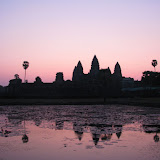
Sunrise--minus the sun. Very crowded on the hill where we could view it, but definitely worth the trip!


We spent about three early morning hours exploring Angkor Wat, before the crowds overrun it. It is by far the most impressive temple in the park (hence why the whole park is named for it). The grounds and towers are massive and from the top you can see out over most of the whole city. The innermost temple (quite a steep stair climb up) is still a sacred site for the Khmer, so you have to cover your shoulders. I had stupidly worn one of the few sleeveless shirts I wore all vacation on that day, so I almost missed out on the experience. Fortunately, a kind tour guide loaned me his scarf so that I could go up with my husband. In the album there is a sad picture of Min Gi looking down at me left behind.

Making himself at home.


The other temples on the "Grand Circuit" were less crowded than the "Little Circuit" and much more interesting. My favorite temple site in the whole complex was Ta Prohm, known as the "jungle temple."

Ta Prohm was half nature, half ruin. It was amazing and totally kicked the Tomb Raider temple's butt for awesome gnarly trees destroying the stone walls.


Min Gi leaves a wake of destruction in his farmer-hat-wearing trail. (caption credit to Leah).


I think I took many of my favorite pictures from the whole trip on this day, so you really should check out the full 104-picture album:

Angkor Wat and the "Grand Circuit" Temples

Angkor: Day One!

Let me entertain you!


I'm finally starting to post about the honeymoon--it's only been a month since we departed Korea for Siem Reap, Cambodia. Siem Reap is best known for being the city nearest the Angkor Wat archaeological park. We spent three days exploring the temples and surrounding areas. On the first full day, our tuktuk (a passenger trailer pulled behind a motorcycle--perfect for transporting two people) driver, Tee, took us to Angkor Thom and then around to some surrounding temples on what's called the "Little Circuit."

The main temple at Angkor Thom, Bayon, is distinguished by the 51 towers, each featuring four large faces, said to resemble the great Angkor king Jayavarman under whose reign most of the structures of Angkor Thom were built. You can't go anywhere in this area without the king looking at you. Creepy.


Min Gi imitating one of the many Hindu art reliefs.


The terrace of the elephants at Angkor Thom.


The small children selling souvenir trinkets all around the temple sites are persistent, heartbreaking, and clever. Both Min Gi and I had a hard time saying "no" as often as we needed to. This young lady had an especially snazzy selling technique--speaking to me in both English and Korean--so I bought a bracelet for Min Gi from her.


Memorably frightening and quite a hefty workout, all of the temples had steep stone stairs, seemingly more suitable for monkeys than people. This temple had some of the steepest. Struck by lightning and therefore abandoned by the superstitious builders who believed it was unlucky, Min Gi in his flip-flops chickened out halfway. I took this picture of him from the top. Ha!


At the temple where Tomb Raider was filmed.


To see all of our pictures from the first day at Angkor, check out the photo album:

Angkor Thom and "Little Circuit" Temples

Thursday, February 18, 2010

Cambodian Smells...

Suosdei! (Hello!)

Cambodia smells like a verdant, dense jungle, far off in the distance. Like motorbike exhaust from the tuktuks--passenger carts pulled behind the bikes. It smells of garlic and ginger, fish sauce and green onions. Of dust--all over the marble sandstone temples and roads. It smells like burning trash and dung, like a muddy, dried-up (because of the season) lake once filled with fish, now allowed to become over-fished and polluted by a corrupt and exploitative government. It smells of mosquito spray and sweat, of fresh pineapple and exotic flowers. Of incense at the temples and crap from the poor plumbing.

Cambodia is intense and beautiful, its people friendly and desperate, its history glorious and devastating. I am loving it here.