Showing posts with label immigration. Show all posts

Monday, January 17, 2022

Colonialism, Education, and Hope: Reflections on MLK Day 2022

"We in the West must bear in mind that the poor countries are poor primarily because we have exploited them through political or economic colonialism." --Martin Luther King, Jr.

In my doctoral program, we're learning about the different theoretical lenses that researchers use in educational research. One of the reasons to consider theoretical lenses is to understand that what we believe about the creation of knowledge impacts what kinds of knowledge we can explore as researchers. Since my program is committed to social justice and equity, we include critical theories in our study--including Critical Race Theory, Intersectionality, and Queer Studies. While these concepts have taken some heat from the right, they are really interesting to study. One of the concepts that I've encountered in my studies is the extent to which the lens of settler colonialism permeates the thinking, research, and structures of education.

Although I had a vague understanding of colonialism from my studies of history in school, my understanding was always that the bad parts of colonialism was something that happened a long time ago or in far away lands. Sure, it was reawakened by the Monroe doctrine and then rhetorically evoked in science fiction I loved as a child (THE FINAL FRONTIER!), but weren't some concepts of exploration and discovery the very foundations of science--exploring the unknown?

But settler colonialism asks: "Unknown to whom?" "Explore for what?" "Who benefits from this interaction?" So many of my questions for educational research are simple questions students already know the answers to, but the academy has not included their perspectives in "empirical studies," and so the knowledge they possess about education is not acknowledged. But if every student knows and understands that the system of testing we have right now is torture, then it's fairly presumptuous of us to have to "prove" the harms.

In the last year, between my graduate studies and increased reading of Native American writers (including Angeline Boulley, Tommy Orange, and--my new favorite--Louise Erdrich), I'm starting to see that the harms of colonialism are ongoing and continuous. That many of the ideals I value in American culture--self-reliance, individualism, creative use of resources, thirst for knowledge--are predicated on the fact that my European ancestors saw the world as theirs for the taking and exploring (and exploiting). That my husband's country was shaped first by the forcible colonization of Korea by Japan and then the de-facto Cold War colonization of the American army. That the "adventure" I loved about traveling to different countries and experiencing other cultures came at a cost to the people and lands I visited.

The trouble of course is, I'm not entirely sure what to do with this knowledge. I love to travel, but the more I learn about the carbon footprint of commercial flights, the more unethical it feels. I want to visit Hawaii and Puerto Rico, but the problematic ways twentieth century U.S. annexed these lands without the support of the indigenous populations, in part because they represent a kind of fantastical, exotic travel for Americans, gives me pause. I can't even think about my own time in Korea as an English teacher without understanding the complex ways that was another kind of colonization project, albeit ones Koreans themselves submit to in order to gain global power.

More troubling perhaps still is the colonial project of public education that continues in 2022. Again, Covid has us asking: "What are schools--warehouses for children so their parents can be participants in the economy or places of academic instruction or social welfare programs for reducing inequity?" (HINT: They are all of these things, none of these, and more.) "Who benefits from schools closing? From staying "open"?" And so on. Some of these questions are public health questions, sure, but they have revealed to me a troubling narrative I believe that public education is capable of (and should) "save" children by helping them navigate the norms of our society successfully. And what is that but a demand for assimilation by another name?

I'm thinking about this today, on a great day for reflecting about injustice, because the first writer who helped me understand the deep connections between all kinds of injustice and harms in this world was Dr. King.  His ability to see how the evils of capitalism, racism, and militarism were interconnected to exploit and suppress others allowed me to understand that there is no single injustice more important than others. What I am most inspired by is his ability to not only see the evils in the world, but to continue to believe it could get better. Sometimes, I really wonder if it can.

I don't have any answers here. I try to do what I can, where I can, but times like these, it can seem overwhelming and that there are no good choices. So instead, I will lean into Dr. King's hope and advice for persistence:

"For all of us today, the battle is in our hands. The road ahead is not altogether a smooth one. There are no broad highways to lead us easily and inevitably to quick solutions. We must keep going." --MLK

Tuesday, April 5, 2011

Korea isn't the only country screwing foreign teachers...

When I worked in Korea, one of the "hot topics" that Korean bloggers who were English teachers enjoyed (endlessly) blogging (and complaining) about was how some disreputable and shady hagwons liked to exploit their foreign English teachers and screw them out of money, time, and benefits promised them in contracts or guaranteed by Korean labor law.

Newsflash, children:  Korea isn't the only offender in the screw-the-foreign-teacher game.

My very own employer in the U.S., Prince George's County Public Schools in Maryland, is in hot water for failing to comply with U.S. labor laws regarding paying the visa fees for foreign employees.  In today's Washington Post article by Robert Samuels, "Federal investigation: Pr. George’s owes foreign teachers millions," PGCPS was sanctioned by the Department of Labor on behalf of mostly Filipino teachers recruited for math and science positions.  They were called a "willful violator" of labor law:
School officials recruited the foreign instructors for classes such as math and science that were hard to fill but then required that the teachers cover thousands of dollars in expenses related to getting temporary work visas — expenses that, Labor Department officials said, should have been covered by the system. That violated laws requiring that U.S. and foreign teachers be compensated equally.

Federal officials have labeled the Prince George’s County Public School System a “willful violator’’ of labor laws and could forbid it to get any more temporary work visas, the majority of which were given to educators from the Philippines.

Our defense?  "We didn't know."  It is so like PGCPS to plead incompetence in order to wriggle out of what amounts to a criminal finding.  They are now open to civil lawsuits on the matter.  As if we didn't have enough budget problems.

Now, I will admit that I do not work for the most reputable of counties.  They do not have a history of treating teachers well and frequently have "scandals" at all levels of administration (most recently our County Executive was indicted for corruption and removed from office in February of this year).   There's a reason I'm leaving at the end of this school year and never, ever looking back.

However, it will be hard now for the screwed over EFL worker in Korea to now claim that it would "never" happen back in America.  It just did.

Sunday, November 7, 2010

Settled?

We unpacked the final box we'd shipped from Korea last week and attended an American Halloween party.  Min Gi got his social security card and his driver's license.  Tuesday, I have a doctor's appointment.

It feels like something's shifting.  Like maybe I can start to relax just a little and move on with life goals--the ones I put on hold to accomplish this nightmare relocation.  This move has been so all-consuming that I'd almost forgot I even had them.  NaNoWriMo is helping a bit.  As is the Couch-to-5K running program I restarted this week.

I marvel at how different life was six months ago--when we didn't yet have our visa or even tickets for the U.S. and I had no idea how I was going to find a job and get everything done I needed to do to wind us up on the other side of the world with our cats and without being completely broke.

Well... we did it.

I'm still not completely happy here in America.  I don't know if that's the adjustment, reverse culture shock, or the shortening days (winter is never easy for me), but I do know that I'm starting to feel settled.  That this house and this job are starting to feel like "mine" instead of just the place I live and the place I teach.  It helps to have found places for everything; it helps that I've been able to plan out the quarter, rather than going day by day/week by week with my lessons.

As I enter the first American "holiday season" I've had in almost four years, I feel unwound.  Like I've been a tight coil for a year and half of short-term, high-pressure goals--all achieved, all stressful, many fun (to name a few:  completing grad school, planning a wedding and honeymoon, getting Min Gi's visa, moving to America and repatriating, dealing with a new chronic illness)--and now I have no bounce.  But maybe I can use this flexibility and rest to my advantage.  Use it to sift through my new identity as wife.  As American-in-America.  As high school English teacher (maybe, in the near future, drama teacher).  Use it to work on my health, my career, and my writing.

Let's hope.  I need some inspiration!

Wednesday, September 15, 2010

Min Gi Arrived! New Job and Townhouse...

On Thursday, my lovely and wonderful husband arrived in America to begin the U.S. chapter of our life together.  He is now an official permanent resident of the United States, on his way to citizenship in a few years (if all goes according to plan, which it rarely does).

I have to say that for the last month, I've been in a major funk.  Most of this is attributable to my job struggle and stress (which I absolutely must blog about, but felt very uncomfortable doing as it unfolded for a variety of reasons--not the least of which was what might happen if potential employers discovered my blog) and not having my own place for the first time in my adult life without a definite plan for obtaining (and affording) one soon.  With Min Gi here again, I realize that a big part of it was also missing him.  He calms me down from my often irrational and uptight self and brings me back to reality. So, it's good to have him back.  He has also promised to start blogging (mostly in Korean, some in English perhaps), so I will be linking that blog soon.

As I mentioned, I have been offered and accepted a full time English teaching position at a small high school in the same county where I worked before going to Korea.  The position is for ninth grade regular level and an inclusion (half special education students) class, but my schedule is not completely definite at this point because the long term sub who I will be taking over from has been teaching a history elective that will be moved back to the social studies department, leaving me one class short.  It's A-day, B-day style block scheduling, but the ninth and tenth grade classes that are not honors level meet every day to prepare for the Maryland High School Assessment (HSA) which occurs at the end of English 10.  This is good for both the students, who get extra practice, and for me, who will have a smaller overall student load.

I took this job for many, many reasons beyond the fact that it was the first full time, contracted teaching position offered to me (though it was that, too).  In fact, before accepting, I had been very excited by a long term sub position in another county with an offer to move me into contracted as soon as a spot opened up--a county with a much better reputation for both education and for teacher support than the one I'm working for (again).  However, this school impressed me.  First off, I ran into the woman who trained me in the Resident Teacher Program I took to become certified six years ago while waiting for my interview.  We caught up, and since she works there as an Instructional Coordinator, she was, as always, very straight with me about the good and bad things about the school.  In the interview itself, one of the Assistant Principals (about five minutes in) said, "I'm not supposed to say this at this point, but I'm going to:  I like you.  I want you to work here."  It's flattering, but more importantly, being desired as a teacher at a school goes a long way towards winning administrators over to your side, which is absolutely necessary as a teacher new to a school.  Finally, they all but promised me Advanced Placement classes next year (which I LOVE teaching) and that they would support me in establishing a school theater program (this school has none).  I was sold.

The school is a bit out in the country, but I like that.  Yesterday (with the great assistance of my brother and good friend Michelle), Min Gi and I have moved to Waldorf, which is in Southern Maryland, a five minute commute from my new job and about 30 minutes from DC.  We took a two bedroom townhouse for us and the cats, ensuring plenty of space for any family members or friends from Korea who would like to visit.  Fortunately for me, Waldorf is also an area where I have a number of friends, thanks to my previous work with a community theater in neighboring La Plata, the Port Tobacco Players.  (As a welcome home present for Min Gi, I got us tickets to their production of Arsenic and Old Lace, which was fantastic, although it closed this weekend.)

So now, other than the insomnia from drinking too much caffeine to help with moving yesterday and the fact that the cats and a few boxes are still at my parents' house (hopefully this will be resolved today), we have accomplished my major goal for the year, which was to move us all here and find a good job.  I start teaching Monday, and while I'll do some prep work this week and attend back to school night this evening, I don't intend to stress any more about jobs until after I've begun working!

And that's what's been going on.

Monday, August 30, 2010

Q & A: Non-white women; Internet hook-up; long flight tips; Marine base in Vietnam; Korean Tuesdays

It's been a long time since I've answered my formspring questions. Sorry to those of you who'd been waiting on an answer.

Do you see colored girls in Korea? Like blacks, Hispanics or mixed girls? I mean I often here stories of Caucasians dating up there but...I'm curious.

I'm not exactly sure what perspective you are coming from (are you a man who wants to hook up with "colored girls" or what?), but I will answer. There are many non-white, non-Korean girls living in Korea. The largest groups I've encountered are Chinese and Filipina students and African-American and Hispanic soldiers. In the English teaching community, they are about proportional to what you would find among college grads from the seven countries eligible for E-2 visas, except that there is about a 70/30 male/female ratio and a much higher percentage of people with any Korean blood within that teacher community compared to a normal population. I come from a very, very diverse part of America, so I tend to think the foreign English teacher community is not very diverse (mostly white, middle class). However, people from less diverse areas think that the expat teaching community is very diverse. So I guess it depends on your perspective. If you actively seek out non-white women, you will find them, but I seriously doubt you will be impressed by the number of them you find (except in certain areas of very large cities). I will say that in Korea, more of my non-Korean friends were white than anywhere else I've lived/worked in my life except during college.

My husband is thinking of going to South Korea to be a teacher, I was wondering how long it took you to get internet hooked up in your apartment?

Your husband wants to go to South Korea, and the only question you have is about length of time for internet hookup? You have some restraint, m'dear. Depending on which service you choose and how well supported you are at your school by the teachers who take care of these things, it could take between 3 days and 2 weeks from the time people start asking around. However, in my first apartment, internet was already set up. In my second apartment, Min Gi shopped around for good deals for about a week and then found one and a week later, I had internet. In the last apartment, we transferred the contract from the second apartment, and I think I was without internet for only a day or two. South Korea prides itself on being the most wired country in the world. It's not for nothing.

How did you deal with the long flight over there? I want to travel but I hate to fly. Any tips for getting through it?

I like to deprive myself of sleep and fatty foods for the 36 hours prior to takeoff. I sleep better on the plane that way, and sleep so well the first night that I usually only experience mild jet lag after. On the plane itself, I read, listen to music, doze off, get up and walk around/stretch, play with the in-flight entertainment center, and always ask for at least 2 cups of water when they come around and offer. Sometimes I find the free red wine helps me zonk out even more quickly, but be careful about hydration. Planes are nastily drying environments.

Are there any remains of the Marine base at Marble Mountain???

I was not specifically looking for the Marine base at the Marble Mountains in Vietnam. However, I recall there was a marker for the lookout point the Americans used and the platform was there and my motorcycle taxi driver mentioned the base (he was a South Vietnamese soldier during that time). The effects of war there struck me more in the extreme shell damage to the temple sites and ancient carvings.

I remember reading how you and your husband speak English at home and every Tuesday it is Korean language day. So now that you are coming back to America, will you do a language swich-a-roo to keep in practice? I would think speaking Korean back in the US [would be helpful].

As you recall correctly, we usually speak English at home and for awhile we were doing Korean on Tuesdays. Right before I left Korea, Min Gi was in hardcore English study mode because he hopes to be able to work and function comfortably in his new country, so my Korean studies were sadly neglected. Currently, we are in separate countries, so I am not speaking much Korean at all these days, with him or anyone else. We will probably speak English at first in America because we are going to stay with my parents, and it is a little rude to speak another language around people who don't understand it when everyone is perfectly capable of communicating in the host's language. I would like to re-start the Korean Tuesdays when we are set up in our own house and then perhaps increase it to 2-3 days a week, as my Korean studies pick up more and I grow my skills.

That's all the formspring for now, but feel free to ask me a question anytime. I'm less crazy stressed now that the move to the U.S. is about 50% complete, so I should get to answering them faster.

Wednesday, August 18, 2010

Wednesday Review--We Married Koreans: Personal Stories of American Women with Korean Husbands

We Married KoreansI know I haven't done a book review in a long time; rest assured that it is not because I have gone the last few months without reading. Quite the contrary. In the last few months, I've been in a mad reading frenzy in an attempt to rid myself of all the books I had accumulated in Korea that I did not wish to bring back with me to the U.S. Fortunately, I discovered Bookmooch and an English used book cafe called Buy the Book (Downtown Daegu, above the Mr. Pizza on the main street with Communes and Billibow and the like), so all of my books went to loving homes.

One of the books I did want to keep with me, however, was We Married Koreans, a collection of 12 true stories of interracial, intercultural marriages between American women and Korean men in the 1960s. The collection is edited by Gloria Goodwin Hurh, whose own story appears in Chapter 5.

If you have any interest in American or Korean cultures during the last 50 years or in intercultural marriages in general, you should read this book. Do not be put off by the fact that it is self-published and therefore contains some errors in grammar and usage that (hopefully) would have been caught by a professional editor or that the women are not professional writers. It tells a fascinating history, both personal and cultural, of Korea as it struggled towards democracy (one woman's husband was imprisoned for anti-government demonstrations in Korea) and America as it struggled towards racial equality (many of the women speak frankly about some of the racial epithets hurled at their children). The couples mostly met, married, and lived in America, but most lived for at least a short time in Korea and one missionary couple spent most of their marriage in the Korean expat community in Brazil. I feel like I just sat down and read 12 very good personal blogs about Korea.

Each woman speaks positively of marriage and praises intercultural marriage, despite the challenges they have faced. None of them have divorced and most stories are accompanied by a picture of the couple from within the last five years, graying and wrinkled, but still together. I was particularly moved by the stories of Faye Moon, Dixie Whong, and Sharon Shin, but I got something new and interesting from each story. Many of the women were Christian missionaries or united to their husband by a strong faith, which did not speak to me as much as it might have to someone from their era, but I still enjoyed reading the book very much.

I can only hope that Min Gi and I will be as happy together in our future as these couples seem to be.

Tuesday, June 15, 2010

Immigration Update

You can read about our immigration journey thus far here and here.

Min Gi just called me from Seoul where he turned in the blue form and my dad's I-864 (the Affidavit of Support) form, W-2s and tax papers for the last three years along with a birth certificate and passport copy for proof of dad's U.S. citizenship (I didn't go with him this time). The ladies at the embassy said that barring anything crazy, Min Gi should get the visa some time next week.

With less than two months until my departure date and less than three months until his, this is a big relief. When the papers arrive, we will bust open the nice Australian bottle of wine we got as a wedding present from Sarah. An occasion well worth the celebrating.

Saturday, May 29, 2010

Immigration Saga Part 2 (Or... Why I Haven't Been Blogging)

Min Gi's interview for a CR-1 at the U.S. embassy in Seoul was on Thursday, May 27 at 8 a.m. I posted about our first round of filing (the I-130 form) a couple months ago. Since then, we've been gathering documents like some long drawn-out scavenger hunt. When I had the final packet assembled and ready to go before our trip up to Seoul, I felt like I did when I'd completed my final paper for grad school last year. It was almost as much work!

To sum up: Interview: Pass; Documents: One Fail. We were blue-paper-ed. I'll explain it all below. Generally, it's a good outcome, but we have to re-file the erroneous document, which means one more trip to Seoul for Min Gi.

What happened: We arrived at about 7:40 and sat on the chairs outside the embassy. However, at about 8:10 we realized they were for non-immigrant visa applicants, so we went into the building.

They did a document intake and told us to wait (the document intake lady was not so nice, but the interviewer was very nice). We were called up again, they took Min Gi's fingerprints (no ink!). They sent us to the cashier to pay ($400-- or 480,000 won that day, you do need exact change if using won). We waited for the interviewer to call us up. We got to watch other couples/families interview at the glass window.

Although the consular interview is designed to be done by just the applying immigrant spouse (because the U.S. citizen or permanent resident already lives in the U.S.), you can do it together if you plan to travel at a later date, you just need to prove future domicile instead of current, which is a bit tricky. Our interview itself was three questions long and the interviewer cut Min Gi off in the middle of answering the question about what he would do in the U.S. saying she wasn't "going to pry any further into our personal lives." We were out of the building by 10:15 a.m.

We followed the checklist provided by the embassy, which included the following documents (with copies of everything because otherwise they might keep the originals):

--Min Gi's passport (valid for at least 8 months)
--two recent passport-style photos
--a receipt for delivery of the visa and passport (you pay cash on delivery; the forms are available at the embassy)
--another set of identification papers (Certificate of Kinship, Certificate of Marriage, and Certificate of Personal Records and photocopies and translations) for Min Gi
--A medical test (this test is very specific and only 4-5 hospitals in Korea are able to perform it; however, the instructions are pretty clear--don't forget your passport and passport photos and $150, though or you'll have to make more trips than you want to; oh yeah, and this is the exception to the copies--DO NOT OPEN THIS ENVELOPE!!!)
--A Criminal History Record for Min Gi from Korea (if you've lived in other countries, you need those records, too) and a translation with a signed statement from the translator
--An Affidavit of Support (Form I-864) filled out by me along with IRS transcripts of my income taxes for the last 3 years and proof of my citizenship (passport and birth certificate), hopefully proving I can support Min Gi financially in the U.S. However, the U.S. gov't does not count my foreign income. This is nice for saving money on taxes, but it means I have essentially earned $0 since August 2007. The gov't does not cotton to poor folk joining them (the Statue of Liberty--she's a-lying). Therefore my dad agreed to help me out--this is where we made a mistake!!!
--Proof of Domicile in the U.S. To prove I was moving to the U.S., I included my contract showing the end date in August, a document I signed for work announcing my intention not to renew, my one-way plane ticket, some e-mail receipts for counties where I've submitted job apps as well as correspondence with another job opportunity I'm pursuing, a letter from my mom saying that we will live with them until we can move into our own place and that my belongings in the U.S. are currently stored there, my Maryland state driver's license showing my parents' address, and highlighting the IRS transcripts had been received at that same address. The interviewer complimented me on this stuff, so I think it would be a good model to follow.
--Because I need a joint sponsor (my dad), I had to write a letter explaining why (in case my $0 income was not obvious evidence enough)
--Joint Sponsor's Affidavit of Support. Here is where we made the mistake. I assumed that since I'd had to go through all of those hoops above to PROVE that I'd be living with my parents that dad should fill out the form I-864 A for an adult member of my household. However, they wanted him to fill out form I-864 (as if he were an Independent Joint Sponsor). We also submitted proof of his citizen status (a copy of his passport) and the last three years' IRS transcripts. We have to submit the correct form in order for the visa process to finish. We were given a blue paper listing the document to submit and told that we can show up any Wednesday 8:30-10, sans appointment.

I also had a stack of proofs that we're a real couple prepared. The interviewer didn't even glance at them. There was a lot of wasted energy! (I do recommend you do this as if they are suspicious of your relationship, they could ask you for documentation. We didn't see it happen to anyone, though.)

Lessons Learned:
--Have anyone helping you out fill out both possible forms in case you assume the wrong one--GRR!
--Over-prepare, but don't stress. If you're missing something it's not that hard to fix (being blue-paper-ed is not the end of the world). You don't have to interview again or anything, just visit the embassy on a Wednesday morning.
--VERY IMPORTANT: You must enter the U.S. within six months of the MEDICAL TEST. I thought (because it says so on the embassy site) that you have six months from the visa approval date. As a result Min Gi has to travel before September 11 and will miss Chuseok this year. This is very annoying. However, we now have bought his plane ticket (September 9) which is a load off my mind.

P.S. Thanks Dad for running around and re-doing your part. You've been awesome!

P.P.S. Thanks Kristin who put us up in Seoul the night before. I hope this helps you not get blue-paper-ed.

Tuesday, April 6, 2010

Native Speaker by Chang-rae Lee (Wednesday Review #5)

The first novel by one of the best known Korean American novelists begins in such a compelling way--with a list of the main character's flaws as written out by his wife who is leaving him. However, Native Speaker by Chang-rae Lee follows a twisted and sometimes confusing path through the mid-life of a second generation Korean immigrant and spy, Henry Park, whose current assignment to follow a charismatic Korean-American politician, John Kwang, leads him on his own search for identity.

Lee is a hell of a writer. He plays with words and ideas in a way that sucks you in and reminds me of some of my favorite American wordsmiths--Richard Wright, Tim O'Brien, Cormac McCarthy--while at the same time addressing some of the issues of alienation that make other American immigrant writers, such as Amy Tan, Maxine Hong Kingston, and Richard Rodriguez so powerful. The scenes that stuck with me were the ones between Park and his father and the difficulties he has with his wife and family.

However, I found the structure of the novel off-putting. I don't know that the whole spy gambit was necessary except as a plot device to contrast Kwang's immigrant experience with Henry's father's. I felt that the story was almost so ambitious as to be unfocused. Was it a story about a parent's loss? About a broken marriage? About an American unable to connect with his Korean roots? About political intrigues of minority politicians? I don't know. I felt like Lee may have bitten off more than this story could chew. I'm glad I read it, but I wouldn't jump out of my socks recommending it to others.

That said, I would like to read more of Lee's work before judging him. As I said, I think he can write, even if this story does not grab me. Fortunately, he has three other books I can sink my teeth into when I get back to America. Yay for public libraries!

Friday, February 12, 2010

Immigrating to the U.S.A.

Please note: This entry is for information purposes only. I am not an immigration attorney or any kind of expert on the matter. This is our story, but your circumstances will likely be different.

Min Gi and I are planning the big move back to the U.S. at the end of this contract (in August). This is not a permanent move for us (I love life as an expat), but a choice we're making because at this time, I want to be near my family for a few years and I want Min Gi to get to know my culture the way I've gotten to know his. Additionally, the next time I (now we) go abroad, I plan to do so by teaching in International Schools, not EFL. If I had been smarter, that's the way I would have done it the first time around--a better job for better pay in more countries... but I do not regret the past two and half years in Korea in the least.

Since we planned to live in the U.S. for two years, we did some reading and realized that there is really no such thing as a nonimmigrant visa for spouses (ok, there IS, but they assume you'll apply for a Permanent Resident Card or "green card" as soon as possible). Yes, the U.S. government is arrogant enough to assume that anyone who wants to live there for a period of time automatically wants to live there forever and become a citizen. Fortunately, we recently realized that Korea might change its mind about allowing dual citizenship, so it might actually be worth it for us to go through this process now anyhow, but that's just an added bonus.

Thanks to some very helpful conversations with Amanda, who went through this process recently in the U.S., and J.R., who went through the U.S. embassy in Korea as we are now doing, we've managed to proceed pretty far in the whole complicated mess of U.S. immigration, so I thought I'd take the opportunity to update you all and share some invaluable resources to help you through it, if you're drowning in the tidal wave of bureaucracy.

If you are trying to get your Korean spouse a Permanent Resident Card, you have two options, based on where you live. If you are currently in the U.S., you go through a Change of Status (COS). If you live in Korea, then you might be eligible for the much speedier, more convenient, and cheaper direct consular filing (DCF) process (note in countries not as friendly with the U.S. or with more sham/mail-order marriages, the DCF process may not be any easier or less complicated than COS). Fortunately, Min Gi and I qualify to apply from Korea.

I started by purchasing and reading the book Fiance & Marriage Visas: A Couple's Guide to U.S. Immigration by Ilona Bray, J.D. The book is thorough, up-to-date and gives advice like an immigration lawyer would. Since our immigration is rather uncomplicated (neither of us have kids or were married before, he's never lived in the U.S. before or entered the country illegally or overstayed a visa, and neither of us have any exclusionary conditions, like being a criminal or having AIDS) we decided to go it alone, without legal representation.

My next stop was to read everything available on the U.S. Embassy in Korea's website about getting married in Korea and obtaining family visas. I also read the success story of another couple who went through Korea's DCF on the supportive website for people dealing with this process, visajourney.com. We started gathering all the forms and talking openly with my parents about what we need from them since before we visited them this last July/August. Information and advance planning are power!

Turns out the kind of visa we will apply for is CR-1 or a conditional resident visa. Conditional because we've been married less than two years. That means we'll need to submit more paperwork two years after moving to the U.S. What we've done so far:

January 6, 2010: We got married through the U.S. embassy and the Korean district office in Seoul. This was rather easy to do, even though we made a mistake on the forms and had to make a couple extra trips back and forth. One piece of advice: Make sure your Korean fiance has the names and government ID numbers of two family members willing to vouch for you (like witnesses). Technically, they are supposed to be there to sign it, but I think if they're family, just the information will do. Min Gi called the district office twice to ask about this and both times they said you don't need it, but of course when we got there, they said we did. Cost: US $90 payable to the embassy: cash (dollars or won) or US credit card.

February 1, 2010: We had made an online appointment to file form I-130 Petition for Alien Relative and the required biographical forms G-325A for each of us.
Submitted materials:
--Form I-130
--Form G-325A for each of us
--Passport-style photos of each of us
--My passport and a photocopy
--His passport and a photocopy
--My Korean Alien Resident Card (ARC) and a photocopy (I forgot the photocopy and it was ok)
--My birth certificate and a photocopy
--Our marriage certificate (from the US Embassy-ha!) and a photocopy
--Three documents from the Korean Family Census Register: Certificate of Kinship, Certificate of Marriage, and Certificate of Personal Records and photocopies
--Translations for the above (Min Gi found a blog that had good translations here.)
--A signed statement verifying the translations (We had our friend Leah do this. Min Gi thought we should get it notarized, but the fee was a lot, and I was certain it was unnecessary. Since our copies were not notarized, the embassy kept the original Family Census Registers, so we had to get new copies from the government office, but they're only $1 each; the notarization fees were around $40 per paper)
--Fee for filing: $355 (426,000won) payable in Korean or US cash only.

Although the website said that I could file the papers at the embassy alone, it was good Min Gi came with me because he had to fill out a paper about his contact information. Lo and behold, three days later he was e-mailed packet 3.5 and told to apply for a visa appointment.

We applied for the visa appointment and requested a date in May when I wouldn't have classes. They granted us one of those days! Our appointment is scheduled for May 27, 2010 at 8 a.m. We could almost certainly have gotten an earlier appointment if we weren't picky about dates or if we were in a rush. We also completed and mailed the first part of form DS-230, conveniently available in a dual language form, so that they could start his background check prior to the interview.

We have more documents to gather before the interview (most notably some "bona fides" that prove our marriage is real and the Affidavit of Support showing we won't be on the government's dime when we move to the U.S.). Min Gi also has to get a medical exam ($150 and requiring a trip to Busan for him) and his police record. We will also have to pay another $400 for the interview fee (yes, this process is a tad pricey). However, overall the U.S. embassy has been efficient, kind, and helpful in the whole process and our advance planning has allowed us to squeeze all of this work into just a couple hours a week so it's been quite manageable.

I'll update you about the interview itself after it is completed. I hope, for those of you undergoing or considering this process, that this post was somewhat helpful. And for those of you who like to complain about the E-2 visa process for Korea, maybe you'll realize just how lucky you have it. Because the work visa process for the U.S. is not all that different or less expensive than the process I've described here.

Monday, February 8, 2010

Seoul Adventures (Hongdae Night; Jongmyo)

I briefly mentioned that the last weekend of January Min Gi and I traveled to Seoul. We had two main goals: 1) File the first round of immigration papers for Min Gi's becoming a U.S. Permanent Resident and 2) Go skiing for the first (and only) time this season, the second time in Min Gi's life (the first was my Christmas present to him last year). However, I'm not going to blog about either of those here. I'm going to blog about the extra adventures we took while we had a chance to visit Seoul again, sans the whole family clan.

Hongdae Night

We arrived in Seoul on a Friday evening, hungry and excited. We decided to look around the Hongik University area (or "Hongdae" as it is more popularly known). Although it was very cold and we had our backpacks on, we wandered all over the area that I've come to know secondhand through the lovely bloggers of Doing It Korean Style and I lost my mind in Seoul. I even saw the infamous TinPan, advertisements for something called "The Donkey Show" which looks absolutely terrifying, and a bar called Boobi Boobi (you can see photographic evidence of these things in the photo album above). It was club night, but we were there around 7 p.m. so the action hadn't started yet. We would have loved to actually hang out for the party scene, but waking up to go skiing at 7 a.m. is not conducive to a late night.

A night view of the second-floor restaurant.

We found a beautiful little Spanish restaurant called La Paella (guess what it serves?). The chefs were Spanish and the food deliciously spiced and savory (and since we ordered the vegetarian paella, also rather healthy). We devoured it quite fast. I continue to maintain that if I lived in Seoul I would be broke and fat, but my tummy would be very, very happy.

Min Gi, trying to look "cool," with our amazing cafe desserts!

After dinner, we were looking for a coffee shop to rest and talk and discovered a little gem a bit off the main Hongdae strip called Cafe Atre (I believe... it may have been Arte, but it was next to a "Piano Cafe" if that helps you find it). The menu was amazing. Min Gi ordered an iced coffee drink and a scone, while I got a tea called "Snow White's Apple" (complete with apple slice in the cup) and a piece of chocolate "cake" that was more like a brownie. The atmosphere was very comfortable and although cutsey (like all of Korea), the wooden beams made it feel like a converted barn and was kind of rustic for Seoul.

We found a nice motel in nearby Sinchon and met our tour bus to Phoenix Park the next morning. We returned to Seoul late on Sunday, ready to file the paperwork at the U.S. embassy on Monday morning.

Jongmyo, Royal Ancestral Shrine

After filing the paperwork, we headed to one of the few remaining UNESCO World Heritage Sites in Korea that I have not yet visited, the Royal Ancestral Shrine of the Joseon Dynasty, Jongmyo.

A rare finding in a Joseon monument--a memorial shrine honoring a king from Goryeo.

A small bit of historical information: Most of the ancient sites and palaces around Seoul and Gyeonggido are relics of the Joseon dynasty, which was the last Korean dynasty lasting from 1392 until the Japanese occupation of Korea in 1910, or from the dynasty before that, Goryeo. However, the area surrounding Daegu is Kyungsang-do, which contained the Silla kingdom from the period of the three kingdoms before Goryeo dominated. I must say that, in general, I find Silla art and architecture to be far more compelling and emotional than the more severe and sombre Confucian designs of Joseon. I believe, although I have not done nearly enough research on the matter, that this preference comes from Silla's stronger connection to Buddhism and religion. I admire Joseon's attention to geometric unities and impressive structures, but I am not stirred by them in the same way I have been at temples throughout the Kyungsang provinces.

Min Gi stands on the immense stone platform, upon which the Royal Ancestral Rites and ceremonies were observed, in front of the main shrine building.

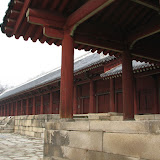
However, at Jongmyo, I did feel a bit moved. Perhaps the gray sky and remaining snow and ice enhanced the impressiveness of the architecture. Or perhaps I was just relieved of the burden of filing those immigration papers, but either way, I was quite speechless in the face of the main shrine area.

Said to be the longest traditional building in Asia, the perfect symmetry of the shrine lends an eerie feeling to the place--like the entrance to the Labyrinth.

After passing through Jongmyo itself, a small foot bridge over a busy Seoul street leads you to one of the less important of the five main Seoul Palaces, Changgyeonggung. Although we were tired from carrying around our backpacks all this time, we explored the grounds a bit.

In front of Changgyeonggung.

All in all, I'm glad I got to see a bit more of Seoul. I'm finally starting to feel a bit more comfortable in that city. Enough so that I think I might be able to live there if I get a job there in the distant future. That's a good thing to know.