After flying all night from tropical, beautiful Bangkok, we arrived to four degree Celsius rainfall in Incheon. While it is wonderful to be home, the ugliness of Korea's concrete buildings combined with the dreary weather and the looming thought of work tomorrow with nary a clue about what my schedule will look like (oh the last minute-ness of everything!) are ganging up to make me yearn for a different lifestyle, for a new country.
I know that when spring arrives, I'll start waxing bittersweet about my last six months (less, actually) in Korea for a few years, but for now, I'm wishing I was back at the beach with a glass of red wine and no responsibilities but to finish my novel and frolic in the waves with my husband.
Many posts about the places we went are forthcoming. For now, I'll just say that we had so much fun, we've decided to have a honeymoon at least once a year.
Monday, March 1, 2010

Wednesday, February 24, 2010
Wednesday Review #3
This entry was pre-written because I am currently on my honeymoon in Cambodia and Thailand!
The Kite Runner by Khaled Hosseini is one of the best books I have ever read. It is also one of the most heartbreaking. In fact, it reminded me in many, many ways of the saddest English novel ever written, Jude the Obscure by Thomas Hardy, a book so depressing that after writing it, Hardy gave up writing prose and stuck only to poetry for the last 20 years of his writing career (although making him one of the few writers to gain substantial, critical acclaim in more than one genre). Just as nineteenth century Jude negotiates faith and identity in a rapidly modernizing England, Amir must reconcile the beautiful Kabul of his childhood with the Taliban-controlled extremist state of 2001 and the split American/Afghan identity within him. Both characters are paralyzed by and must confront their own flawed humanity.
Really this book has been praised so much that it would be impossible for me to add anything new to the conversation, except this: When I read Les Miserables by Victor Hugo in seventh grade, I was up all night weeping and reading. I came to my parents the next morning, eyes bloodshot and completely in earnest, and said, "I have to go to Paris right now." My parents thought this was a cute moment of my melodramatic nature, but really just the book evoked such an intense connection with a place I'd never been that I felt in that instant that I must reconcile the gap between my changed heart and my physical location. After reading The Kite Runner, I feel the same aching need to visit Kabul, Afghanistan.
It is absolutely a must-read, and I cannot wait to read Hosseini's second, A Thousand Splendid Suns.
Thursday, February 18, 2010
Cambodian Smells...
Suosdei! (Hello!)
Cambodia smells like a verdant, dense jungle, far off in the distance. Like motorbike exhaust from the tuktuks--passenger carts pulled behind the bikes. It smells of garlic and ginger, fish sauce and green onions. Of dust--all over the marble sandstone temples and roads. It smells like burning trash and dung, like a muddy, dried-up (because of the season) lake once filled with fish, now allowed to become over-fished and polluted by a corrupt and exploitative government. It smells of mosquito spray and sweat, of fresh pineapple and exotic flowers. Of incense at the temples and crap from the poor plumbing.
Cambodia is intense and beautiful, its people friendly and desperate, its history glorious and devastating. I am loving it here.
Wednesday, February 17, 2010
Wednesday Review #2
This entry was pre-written because I am currently on my honeymoon in Cambodia and Thailand!
Jarhead: A Marine's Chronicle of the Gulf War and Other Battles by Anthony Swofford is an intense, honest war memoir by a Marine sniper who served during the Gulf War in 1990. Swofford's prose is as blunt and masculinely intimidating as the violent, gruff, and deadly figure the so-called "jarheads" cut that earned them their nickname. As with most good war literature, it was very difficult to read, but worth the discomfort and brutality. It was made into a movie that I haven't seen starring Jake Gyllenhaal, but I cannot imagine the qualities that I enjoy in this book would translate well into a movie.
For example, one motif of the book is the letters that are mailed in and out of the barracks in the desert and the power that they held over the marines stuck waiting for the political and economic battle being waged in Washington and Saudi to determine their fate. Swofford writes:
Although I wasn't quite as impressed with Jarhead as with my all-time favorite book (not just war book) The Things They Carried by Vietnam vet Tim O'Brien (it might actually be impossible to impress me more than this book), I found it to be very readable and engaging. It also gives some insight into what the current war in Iraq must be like for the soldiers still entrenched, which is something most of us could do well to remember.
Jarhead: A Marine's Chronicle of the Gulf War and Other Battles by Anthony Swofford is an intense, honest war memoir by a Marine sniper who served during the Gulf War in 1990. Swofford's prose is as blunt and masculinely intimidating as the violent, gruff, and deadly figure the so-called "jarheads" cut that earned them their nickname. As with most good war literature, it was very difficult to read, but worth the discomfort and brutality. It was made into a movie that I haven't seen starring Jake Gyllenhaal, but I cannot imagine the qualities that I enjoy in this book would translate well into a movie.
For example, one motif of the book is the letters that are mailed in and out of the barracks in the desert and the power that they held over the marines stuck waiting for the political and economic battle being waged in Washington and Saudi to determine their fate. Swofford writes:
I was in the Desert, sending out messages worldwide, clamouring for love with my pen. And with each letter I wrote and sealed, parts of me escaped the Kingdom of Saud. At times I thought I might write myself away, fit my entire body and mind into a few thick envelopes, and that way, as a stowaway, escape the ghastly end that awaited me.I find it hard to imagine a movie dramatizing the urgency of the need to write himself away from the war, although this is such a powerful image in a book. I remember seeing the previews of this movie and being uninterested--after reading the book I'm only a little more interested (if you've seen it and liked it, feel free to convince me otherwise).
Although I wasn't quite as impressed with Jarhead as with my all-time favorite book (not just war book) The Things They Carried by Vietnam vet Tim O'Brien (it might actually be impossible to impress me more than this book), I found it to be very readable and engaging. It also gives some insight into what the current war in Iraq must be like for the soldiers still entrenched, which is something most of us could do well to remember.
Monday, February 15, 2010
Hello Honeymoon!
I write this as I wait in the Incheon airport for our flight to Siem Reap. Hooray! Min Gi and I will be on our honeymoon to various places in Cambodia and Thailand for the next two weeks, so updates will likely be a bit inconsistent.
I'm jumping up and down with excitement. Seriously, the French couple next to me is giving me strange looks. Min Gi just laughs. That's good.
I'm jumping up and down with excitement. Seriously, the French couple next to me is giving me strange looks. Min Gi just laughs. That's good.
Sunday, February 14, 2010
Seollal with my new family
Today was Valentine's Day, yes, but it was also the Korean Lunar New Year (설날), which is one of the two most important holidays in this country. Usually Koreans will travel to their hometowns, to the "Big House" (큰집) which is the house of the oldest male relative of the family. In Min Gi's case, this is his uncle's house, although his uncle passed away even before Min Gi's father did, so now his "big" aunt (KeunOhmma, 큰엄마)--the widow of his "big" uncle (큰아버지)--lives there alone. His two cousins and their wives and children were at the house from early in the morning, but before we went to the house, Min Gi wanted me to meet his father.

Min Gi pours out soju to honor his father and uncle.
Korean family graves are usually in the mountains and feature a small mound of grass with a small stone or grass altar space in front of the mound. Every year children (or grandchildren) go to their ancestors' mounds and clean them--cut the grass and place small tokens honoring the dead--usually around Chuseok. At Seollal, there is no need because in winter time the grass is dead. We bowed to his uncle and to his father. He also explained to me that when KeunOhmma and Ohmma pass, they will be buried next to their husbands.

In Shil throws the Yutnori sticks.
After visiting the grave, we went to the Big House and ate a lot of food (I think this is pretty universal for holidays that aren't about fasting). After lunch, we watched the Olympics for a bit and bowed to KeunOhmma and Ohmma (and received money from them). Then the highlight of the afternoon--we used the money for betting on Yutnori. Yutnori is a traditional Korean board game played with four sticks that you throw to determine how you move around the board. It's very silly and dramatic. We split up into teams: the Seongju relatives (KeunOhmma and the cousins and their wives) and the Daegu relatives (Ohmma, Min Soo, In Shil, Min Gi, and me).

Min Gi gets really excited and throws his sticks wildly.
We played four times. Although the Seongju relatives won the first game, we got the next three. The last game was particularly dramatic, swaying wildly back and forth with who was ahead throughout. Finally, Ohmma threw three perfect throws that ensured us the win.

Ohmma dancing with joy over winning.
Check out the album for pictures of some framed photos of Min Gi's grandparents and father, as well as more Yutnori action:
Korean family graves are usually in the mountains and feature a small mound of grass with a small stone or grass altar space in front of the mound. Every year children (or grandchildren) go to their ancestors' mounds and clean them--cut the grass and place small tokens honoring the dead--usually around Chuseok. At Seollal, there is no need because in winter time the grass is dead. We bowed to his uncle and to his father. He also explained to me that when KeunOhmma and Ohmma pass, they will be buried next to their husbands.
After visiting the grave, we went to the Big House and ate a lot of food (I think this is pretty universal for holidays that aren't about fasting). After lunch, we watched the Olympics for a bit and bowed to KeunOhmma and Ohmma (and received money from them). Then the highlight of the afternoon--we used the money for betting on Yutnori. Yutnori is a traditional Korean board game played with four sticks that you throw to determine how you move around the board. It's very silly and dramatic. We split up into teams: the Seongju relatives (KeunOhmma and the cousins and their wives) and the Daegu relatives (Ohmma, Min Soo, In Shil, Min Gi, and me).
We played four times. Although the Seongju relatives won the first game, we got the next three. The last game was particularly dramatic, swaying wildly back and forth with who was ahead throughout. Finally, Ohmma threw three perfect throws that ensured us the win.
Check out the album for pictures of some framed photos of Min Gi's grandparents and father, as well as more Yutnori action:
 |
| Seollal and Yutnori in Seongju |
Saturday, February 13, 2010
Wedding Day Pictures!
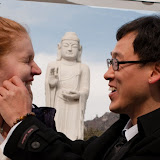
The venue we chose for our wedding was the poorly-lit swing dance club, Asurajang, where we regularly boogie on Saturday nights. It was a great choice to match our personalities and the casual, fun style of our wedding, but it was not at all conducive to photography. We asked our wonderful friend and excellent photographer, Julian, to accompany our families up to Donghwasa for some frozen wedding photography the morning of the ceremony. It was cold and there was snow everywhere--parts of the temple were even closed off because of hazardous conditions, but Julian managed to pull it off, beautifully.


See more:
See more:
 |
| Posed Wedding Photos, at Donghwasa |
Friday, February 12, 2010
Immigrating to the U.S.A.
Please note: This entry is for information purposes only. I am not an immigration attorney or any kind of expert on the matter. This is our story, but your circumstances will likely be different.
Min Gi and I are planning the big move back to the U.S. at the end of this contract (in August). This is not a permanent move for us (I love life as an expat), but a choice we're making because at this time, I want to be near my family for a few years and I want Min Gi to get to know my culture the way I've gotten to know his. Additionally, the next time I (now we) go abroad, I plan to do so by teaching in International Schools, not EFL. If I had been smarter, that's the way I would have done it the first time around--a better job for better pay in more countries... but I do not regret the past two and half years in Korea in the least.
Since we planned to live in the U.S. for two years, we did some reading and realized that there is really no such thing as a nonimmigrant visa for spouses (ok, there IS, but they assume you'll apply for a Permanent Resident Card or "green card" as soon as possible). Yes, the U.S. government is arrogant enough to assume that anyone who wants to live there for a period of time automatically wants to live there forever and become a citizen. Fortunately, we recently realized that Korea might change its mind about allowing dual citizenship, so it might actually be worth it for us to go through this process now anyhow, but that's just an added bonus.
Thanks to some very helpful conversations with Amanda, who went through this process recently in the U.S., and J.R., who went through the U.S. embassy in Korea as we are now doing, we've managed to proceed pretty far in the whole complicated mess of U.S. immigration, so I thought I'd take the opportunity to update you all and share some invaluable resources to help you through it, if you're drowning in the tidal wave of bureaucracy.
If you are trying to get your Korean spouse a Permanent Resident Card, you have two options, based on where you live. If you are currently in the U.S., you go through a Change of Status (COS). If you live in Korea, then you might be eligible for the much speedier, more convenient, and cheaper direct consular filing (DCF) process (note in countries not as friendly with the U.S. or with more sham/mail-order marriages, the DCF process may not be any easier or less complicated than COS). Fortunately, Min Gi and I qualify to apply from Korea.
I started by purchasing and reading the book Fiance & Marriage Visas: A Couple's Guide to U.S. Immigration by Ilona Bray, J.D. The book is thorough, up-to-date and gives advice like an immigration lawyer would. Since our immigration is rather uncomplicated (neither of us have kids or were married before, he's never lived in the U.S. before or entered the country illegally or overstayed a visa, and neither of us have any exclusionary conditions, like being a criminal or having AIDS) we decided to go it alone, without legal representation.
My next stop was to read everything available on the U.S. Embassy in Korea's website about getting married in Korea and obtaining family visas. I also read the success story of another couple who went through Korea's DCF on the supportive website for people dealing with this process, visajourney.com. We started gathering all the forms and talking openly with my parents about what we need from them since before we visited them this last July/August. Information and advance planning are power!
Turns out the kind of visa we will apply for is CR-1 or a conditional resident visa. Conditional because we've been married less than two years. That means we'll need to submit more paperwork two years after moving to the U.S. What we've done so far:
January 6, 2010: We got married through the U.S. embassy and the Korean district office in Seoul. This was rather easy to do, even though we made a mistake on the forms and had to make a couple extra trips back and forth. One piece of advice: Make sure your Korean fiance has the names and government ID numbers of two family members willing to vouch for you (like witnesses). Technically, they are supposed to be there to sign it, but I think if they're family, just the information will do. Min Gi called the district office twice to ask about this and both times they said you don't need it, but of course when we got there, they said we did. Cost: US $90 payable to the embassy: cash (dollars or won) or US credit card.
February 1, 2010: We had made an online appointment to file form I-130 Petition for Alien Relative and the required biographical forms G-325A for each of us.
Submitted materials:
Although the website said that I could file the papers at the embassy alone, it was good Min Gi came with me because he had to fill out a paper about his contact information. Lo and behold, three days later he was e-mailed packet 3.5 and told to apply for a visa appointment.
We applied for the visa appointment and requested a date in May when I wouldn't have classes. They granted us one of those days! Our appointment is scheduled for May 27, 2010 at 8 a.m. We could almost certainly have gotten an earlier appointment if we weren't picky about dates or if we were in a rush. We also completed and mailed the first part of form DS-230, conveniently available in a dual language form, so that they could start his background check prior to the interview.
We have more documents to gather before the interview (most notably some "bona fides" that prove our marriage is real and the Affidavit of Support showing we won't be on the government's dime when we move to the U.S.). Min Gi also has to get a medical exam ($150 and requiring a trip to Busan for him) and his police record. We will also have to pay another $400 for the interview fee (yes, this process is a tad pricey). However, overall the U.S. embassy has been efficient, kind, and helpful in the whole process and our advance planning has allowed us to squeeze all of this work into just a couple hours a week so it's been quite manageable.
I'll update you about the interview itself after it is completed. I hope, for those of you undergoing or considering this process, that this post was somewhat helpful. And for those of you who like to complain about the E-2 visa process for Korea, maybe you'll realize just how lucky you have it. Because the work visa process for the U.S. is not all that different or less expensive than the process I've described here.
Min Gi and I are planning the big move back to the U.S. at the end of this contract (in August). This is not a permanent move for us (I love life as an expat), but a choice we're making because at this time, I want to be near my family for a few years and I want Min Gi to get to know my culture the way I've gotten to know his. Additionally, the next time I (now we) go abroad, I plan to do so by teaching in International Schools, not EFL. If I had been smarter, that's the way I would have done it the first time around--a better job for better pay in more countries... but I do not regret the past two and half years in Korea in the least.
Since we planned to live in the U.S. for two years, we did some reading and realized that there is really no such thing as a nonimmigrant visa for spouses (ok, there IS, but they assume you'll apply for a Permanent Resident Card or "green card" as soon as possible). Yes, the U.S. government is arrogant enough to assume that anyone who wants to live there for a period of time automatically wants to live there forever and become a citizen. Fortunately, we recently realized that Korea might change its mind about allowing dual citizenship, so it might actually be worth it for us to go through this process now anyhow, but that's just an added bonus.
Thanks to some very helpful conversations with Amanda, who went through this process recently in the U.S., and J.R., who went through the U.S. embassy in Korea as we are now doing, we've managed to proceed pretty far in the whole complicated mess of U.S. immigration, so I thought I'd take the opportunity to update you all and share some invaluable resources to help you through it, if you're drowning in the tidal wave of bureaucracy.
If you are trying to get your Korean spouse a Permanent Resident Card, you have two options, based on where you live. If you are currently in the U.S., you go through a Change of Status (COS). If you live in Korea, then you might be eligible for the much speedier, more convenient, and cheaper direct consular filing (DCF) process (note in countries not as friendly with the U.S. or with more sham/mail-order marriages, the DCF process may not be any easier or less complicated than COS). Fortunately, Min Gi and I qualify to apply from Korea.
I started by purchasing and reading the book Fiance & Marriage Visas: A Couple's Guide to U.S. Immigration by Ilona Bray, J.D. The book is thorough, up-to-date and gives advice like an immigration lawyer would. Since our immigration is rather uncomplicated (neither of us have kids or were married before, he's never lived in the U.S. before or entered the country illegally or overstayed a visa, and neither of us have any exclusionary conditions, like being a criminal or having AIDS) we decided to go it alone, without legal representation.
My next stop was to read everything available on the U.S. Embassy in Korea's website about getting married in Korea and obtaining family visas. I also read the success story of another couple who went through Korea's DCF on the supportive website for people dealing with this process, visajourney.com. We started gathering all the forms and talking openly with my parents about what we need from them since before we visited them this last July/August. Information and advance planning are power!
Turns out the kind of visa we will apply for is CR-1 or a conditional resident visa. Conditional because we've been married less than two years. That means we'll need to submit more paperwork two years after moving to the U.S. What we've done so far:
January 6, 2010: We got married through the U.S. embassy and the Korean district office in Seoul. This was rather easy to do, even though we made a mistake on the forms and had to make a couple extra trips back and forth. One piece of advice: Make sure your Korean fiance has the names and government ID numbers of two family members willing to vouch for you (like witnesses). Technically, they are supposed to be there to sign it, but I think if they're family, just the information will do. Min Gi called the district office twice to ask about this and both times they said you don't need it, but of course when we got there, they said we did. Cost: US $90 payable to the embassy: cash (dollars or won) or US credit card.
February 1, 2010: We had made an online appointment to file form I-130 Petition for Alien Relative and the required biographical forms G-325A for each of us.
Submitted materials:
--Form I-130
--Form G-325A for each of us
--Passport-style photos of each of us
--My passport and a photocopy
--His passport and a photocopy
--My Korean Alien Resident Card (ARC) and a photocopy (I forgot the photocopy and it was ok)
--My birth certificate and a photocopy
--Our marriage certificate (from the US Embassy-ha!) and a photocopy
--Three documents from the Korean Family Census Register: Certificate of Kinship, Certificate of Marriage, and Certificate of Personal Records and photocopies
--Translations for the above (Min Gi found a blog that had good translations here.)
--A signed statement verifying the translations (We had our friend Leah do this. Min Gi thought we should get it notarized, but the fee was a lot, and I was certain it was unnecessary. Since our copies were not notarized, the embassy kept the original Family Census Registers, so we had to get new copies from the government office, but they're only $1 each; the notarization fees were around $40 per paper)
--Fee for filing: $355 (426,000won) payable in Korean or US cash only.
Although the website said that I could file the papers at the embassy alone, it was good Min Gi came with me because he had to fill out a paper about his contact information. Lo and behold, three days later he was e-mailed packet 3.5 and told to apply for a visa appointment.
We applied for the visa appointment and requested a date in May when I wouldn't have classes. They granted us one of those days! Our appointment is scheduled for May 27, 2010 at 8 a.m. We could almost certainly have gotten an earlier appointment if we weren't picky about dates or if we were in a rush. We also completed and mailed the first part of form DS-230, conveniently available in a dual language form, so that they could start his background check prior to the interview.
We have more documents to gather before the interview (most notably some "bona fides" that prove our marriage is real and the Affidavit of Support showing we won't be on the government's dime when we move to the U.S.). Min Gi also has to get a medical exam ($150 and requiring a trip to Busan for him) and his police record. We will also have to pay another $400 for the interview fee (yes, this process is a tad pricey). However, overall the U.S. embassy has been efficient, kind, and helpful in the whole process and our advance planning has allowed us to squeeze all of this work into just a couple hours a week so it's been quite manageable.
I'll update you about the interview itself after it is completed. I hope, for those of you undergoing or considering this process, that this post was somewhat helpful. And for those of you who like to complain about the E-2 visa process for Korea, maybe you'll realize just how lucky you have it. Because the work visa process for the U.S. is not all that different or less expensive than the process I've described here.
Thursday, February 11, 2010
My Husband is Odd.
Whenever I adjust the volume on the stereo in Min Gi's car, he often will change it by one number. This behavior confused me (because a one-number change either way usually has little impact on the quality of the sound), but I kind of shrugged it off. He also insisted that our wedding ceremony be 29 or 31 minutes, not 30. I thought he was a little strange, but last night I found out what the big deal is.
I kissed him on the cheek. Two times.
"You have to do one more!"
"What?"
"You have to kiss one more time. One time or three times only. Not two."
"Why?"
"Some people are more comfortable with even numbers. I am more comfortable with odd numbers." He says this matter of factly, like it is the most common thing in the world.
"So you won't accept two kisses? Or four? Or one hundred?"
"One hundred plus one."
Min Gi has no other OCD tendencies, so this "comfort" with odd numbers strikes me as... well... odd.
Wednesday, February 10, 2010
Wednesday Review #1
Last week, I promised to start reviewing a book each week on Wednesdays, and I'm starting to get kind of excited about the project. For one, it will keep me on my goal of reading at least one book a week. More importantly, I believe that the books we read and how we relate or react to them are instrumental in shaping who we are as readers, as writers, and as people. One of the things I love best about my work as a teacher is getting to share books with my students. I guess adding it to my blog means I get to share these books with you.
I promise not to give away more than is given away on the backs of the books without advance warning, so don't be scared to read the reviews even if you haven't read the book. Also, please if you do read the book and have something to say, feel free to comment. And most importantly, if you have a further recommendation for my reading, please also note that in a comment so that I can add that book to my list.
 The 19th Wife: A Novel by David Ebershoff tells two stories connected thematically by exploring polygamy in the United States: a historical fiction and modern day murder mystery. The historical fiction narrative is loosely based on the autobiography of Brigham Young's infamous wife-turned-activist, Ann Eliza Young, the Ebershoff fills in some of the details left unexamined by her much hated (at least by Mormons trying to erase the ugly history of their church) tome, Wife No. 19. Set largely against the background of Mormonism's origins in the midwest and their exodus to Utah, the book directly addresses one of the most controversial early practices of the church, polygamy or "plural marriage", under the first two prophets. However, at some point in the book's manufactured historical documents, we pull back and realize we are following the work of a young, feminist, Mormon scholar, Kelly Dee, as she attempts to reconcile the church she knows and loves with its dark past, as criticized by Mrs. Young who turns out to be Kelly's great-great-grandmother.
The modern day scenes center around a break-off polygamist sect (many would say crazy, cult-like sect) called "the Firsts." The main character is a young man who was kicked out of the cult by his own mother for violating the Prophet's will and returns when his mother is accused of the murder of his father. His mother is, interestingly enough, his father's 19th wife. Through him and other characters, we can see the emotional effects on children of polygamy; for although Mrs. Young was passionate in her protestation of the practice, the Mormon church has largely dismissed her as a greedy opportunist who was made rich by exposing the church in a sensationalist manner.
Now, I have a weird fondness for all things Mormon, ever since doing a project about the church for my Comparative Religions class in high school, but I don't think my odd inclination was the only thing that caused me to devour this 500+ page novel. Ebershoff is a gifted writer with an ear for voice and character. Like all good historical fiction writers, he doesn't get too bogged down in the details--the story is always first. Every now and then the story dragged, but never for more than a few pages, which is impressive in such an academically-oriented and long book.
I say, give it a read. Especially if you have any curiosity about religions in America or the history of the western states.
Subscribe to:
Posts (Atom)